


Man to man defense is a team defense in which each of the five defenders is responsible for one opponent, while still helping teammates every time the ball moves. Coaches from youth leagues to the NBA use it as their base because it makes every player accountable for a matchup, contests shots all over the floor and builds the help habits every other defense relies on.
Most programs boil man to man defense basketball rules down to five: keep the ball out of the middle, make ball reversal hard, never give full help from one pass away, never let a cutter slice in front of you, and move while the pass is in the air.
Teach it over four weeks. Week one is stance and footwork with the defensive slides drill, week two adds 1v1 denial and the closeout drill, and week three builds 2v2 help and recover, then the shell drill at 3v3 and 4v4. Week four goes live 5v5, scoring stops instead of baskets.
Objective
Give every defender a clear job on every pass (pressure, deny or help), so the ball stays on one side, drives meet a second defender and each possession ends with a contested shot.
Setup
- Area
- Half court
- Players
- 5 defenders vs 5 attackers in a 4-out 1-in set (start 4v4 without the post player)
- Equipment
- 1 ball, bibs in two colors, 4 cones for the perimeter spots
- Duration
- 20–25 minutes
How it works
- 1
Pressure the ball
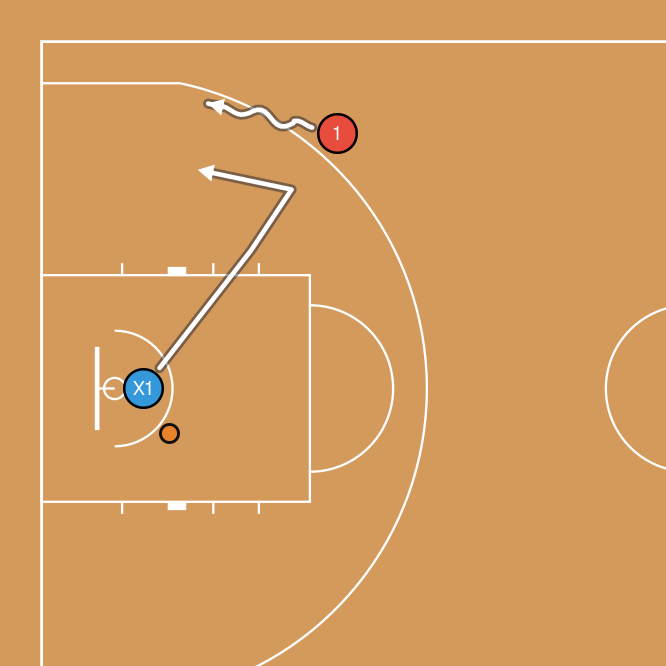
X1 guards the ball at about an arm's length, nose lined up on the ball, feet a little wider than the shoulders. The top foot sits slightly ahead so any drive is steered toward the sideline and baseline, never the middle. Once the dribble is picked up, X1 closes the gap and crowds the pass.
- 2
Deny one pass away
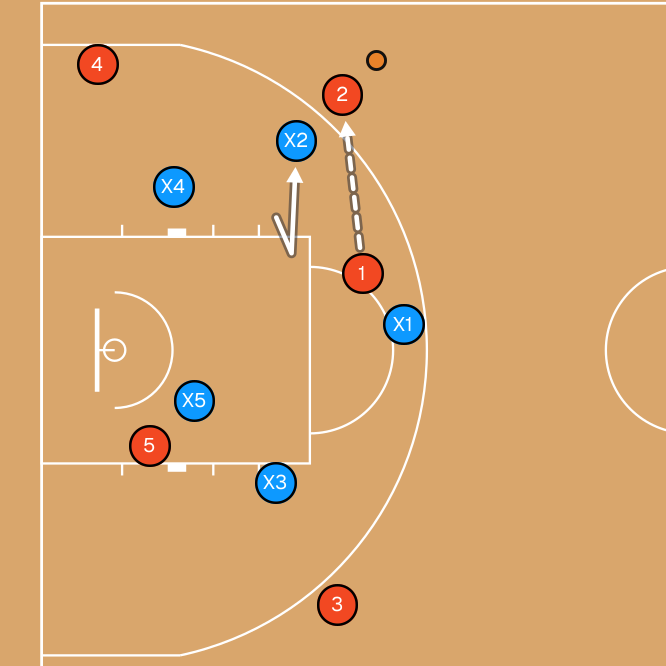
Defenders one pass from the ball stand a step off the passing line and a step toward the ball, which coaches call up the line. The lead hand sits in the lane, thumb down. That is denial defense at its simplest: push the catch away from the basket.
- 3
Sink to help two passes away
Weak-side defenders drop to the help line, the imaginary line from basket to basket, feet near the middle of the lane and a step or two below the ball. One hand points at the ball and one at their player, a flat ball-you-man triangle. In the NBA a defender may not stay in the lane longer than three seconds without actively guarding someone (Rule 10, Section VII); US high school and youth rules have no such limit.
- 4
Help and recover on the drive
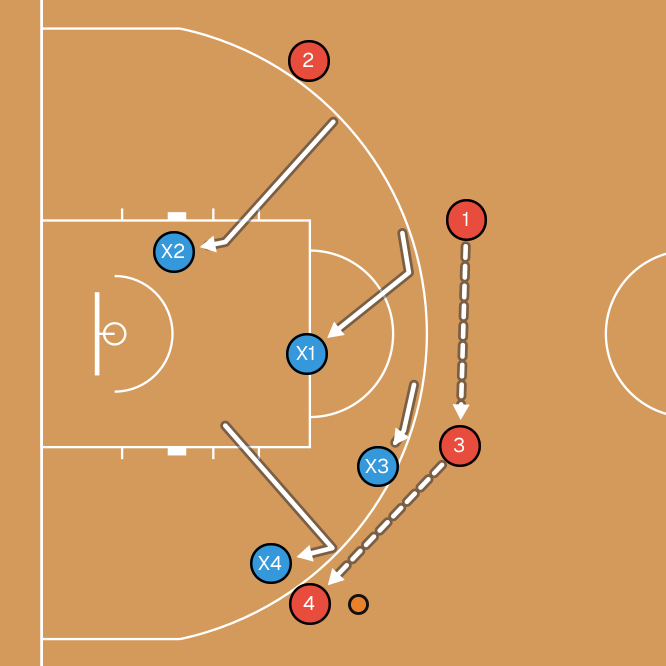
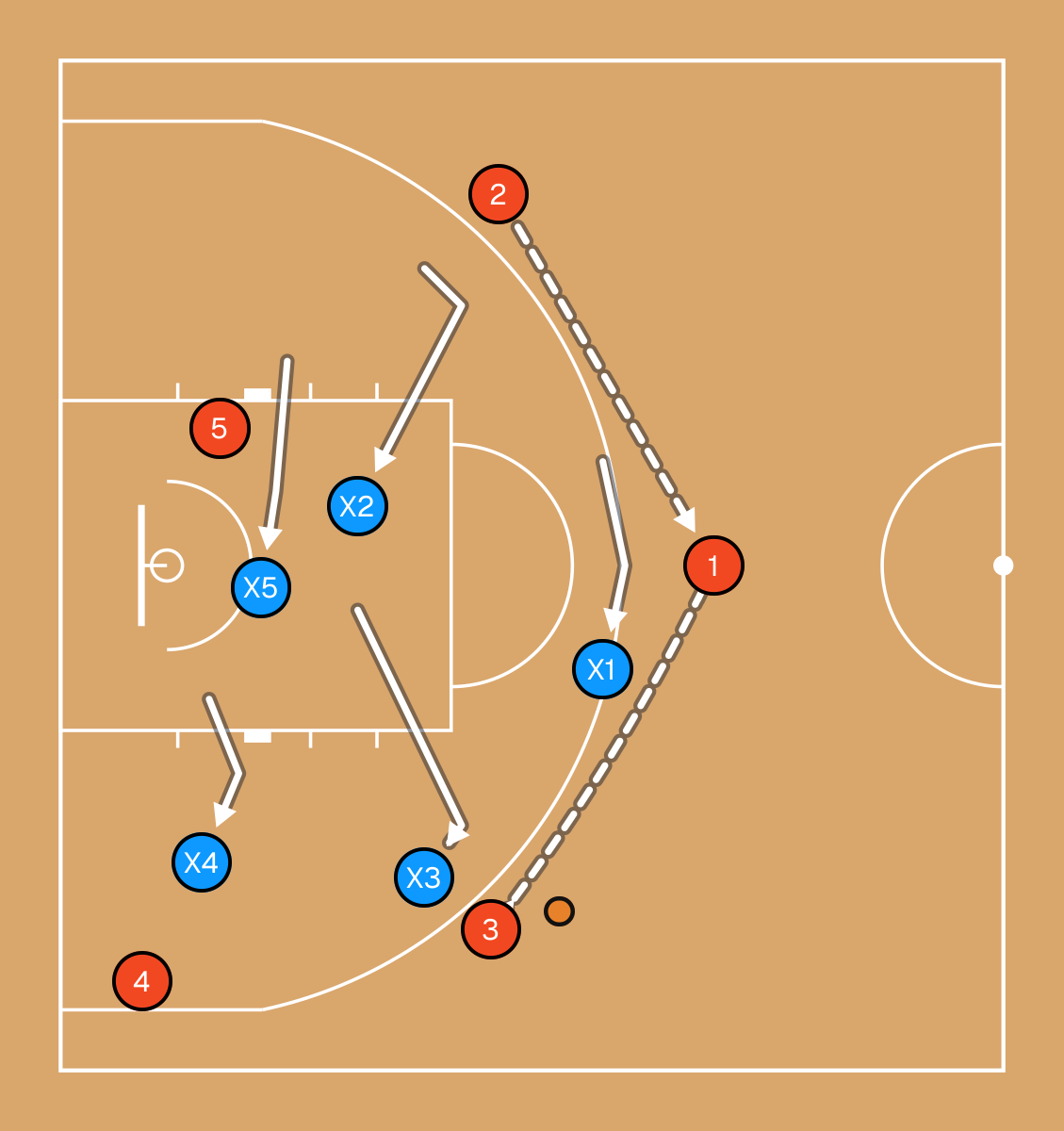
With the ball on the left wing, 3 drives baseline past X3. X4, guarding 4 in the left corner one pass away, is the closest body, so X4 steps up into the drive with both feet set outside the restricted area where one is marked. When 3 kicks out to 4, X4 recovers and closes out while X3 sprints back to 3. Good help defense is two efforts: the stop, then the recovery.

In this play
Man-to-man defense: help and recover on the drive
Help and recover in man-to-man defense: 3 drives baseline past X3, X4 steps up from the corner to stop the drive, and when 3 kicks to 4 in the corner, X4 closes out while X3 sprints back to 3.
- 3 has the ball on the left wing with 4 in the left corner; X3 guards the ball and X4 sits in help.
- 3 drives baseline past X3, and X4 steps up from the corner to stop the drive outside the restricted area.
- 3 kicks the ball out to 4 in the corner.
- X4 recovers with a closeout on 4, and X3 sprints back to 3.
- 5
Close out on the skip pass
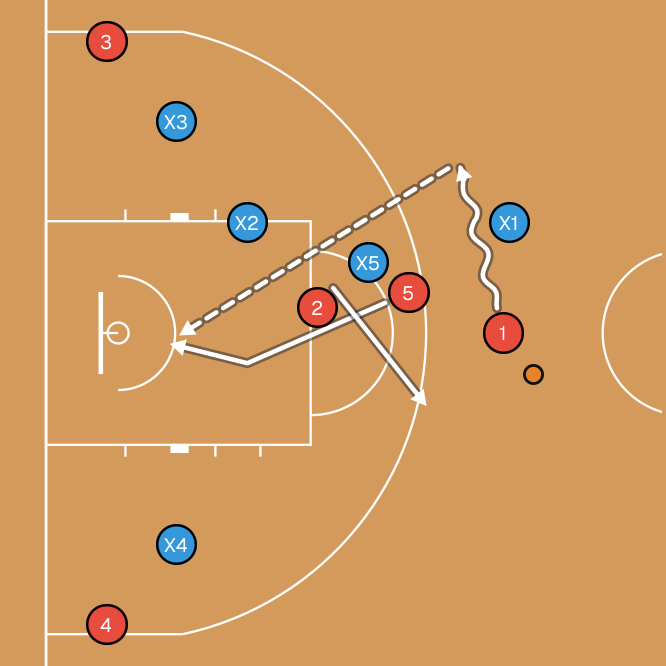
When 2 skips the ball from the right wing to 3 on the left wing, X3 leaves the help spot near the middle of the lane while the pass is in the air. X3 sprints most of the way, then chops short steps for the last two or three. The high hand goes to the shooting hand and the feet take away the middle drive.

In this play
Man-to-man defense: close out on the skip pass
Closing out on a skip pass in man-to-man defense: 2 throws the ball from the right wing across to 3 on the left wing, and X3 closes out from the help spot in the lane with short steps and a high hand, taking away the middle drive.
- 2 has the ball on the right wing; X3 sits two passes away in the help spot near the middle of the lane.
- 2 skips the ball to 3 on the left wing, and X3 closes out from help, sprinting first and then chopping the last steps.
- 6
Switch or fight through screens
On an off-ball screen, the defender guarding the screener calls it early and steps toward the cutter to buy a teammate a step. The screened defender goes over the top against a shooter and under against a non-shooter. Ball screens need a coverage the whole team knows before tip-off, compared in the table below.
| Coverage | What the big does | What the guard does | Gives up | Suits |
|---|---|---|---|---|
| Hedge (show) | Jumps out past the screen to stop the handler's path, then recovers to the roller | Fights over the top of the screen and takes the handler back | The roll and the pocket pass while the big recovers | Mobile bigs and teams that rotate well behind the ball |
| Switch | Takes the ball handler and stays in front | Takes the screener and fronts the roll or the post-up | Size and speed mismatches | Lineups of similar size and quickness |
| Drop | Sinks to the level of the screen or below to protect the rim and the roll | Goes over the screen and chases to contest from behind | Pull-up jumpers and pick-and-pop shots | Tall rim protectors who are slow on the perimeter |
| Ice (down) | Drops toward the baseline side to contain the turned-away handler | Jumps above the side screen and pushes the handler toward the sideline and baseline | Baseline jumpers and quick passes to the popping screener | Side ball screens and teams that keep the ball out of the middle |
| Under (go under) | Holds near the level of the screen while the guard slips beneath | Goes under the screener and meets the handler on the other side | An open shot from behind the screen | Ball handlers who do not shoot well from three |
| Blitz (trap) | Jumps high and traps the handler with the guard | Goes over the screen and traps | A 4-on-3 behind the trap after the pass out | Athletic, deep teams and late-game pressure on a star handler |
Coaching points
Talk on every pass: "ball" from the on-ball defender, "deny" from one pass away and "help" from the weak side.
Jump to the ball on the flight of the pass, because a defender who moves on the catch is already a step late.
Never let a cutter run between you and the ball; bump the cutter with your chest and force the cut behind you.
On every shot, all five find a body and make contact before chasing the rebound, since a stop only counts once you have the ball.
Variations
Pressure man-to-man
Deny every pass one away, including the reversal to the top, and pick up at half court. It creates more deflections and turnovers but invites backdoor cuts, so the help line must be full and someone must shout "backdoor".
Pack line man-to-man
Off-ball defenders stay inside an imaginary line about 16 feet from the rim and help in the gaps instead of denying. It protects the paint and cuts fouls; the full system has its own pack line defense article.
Switching man-to-man
Switch every screen so nobody gets stuck chasing. It needs five players of similar size, and the smaller defender must front the post after switching onto a big.
Build it in Coach Board
Players stop guessing where to stand once they see all five defenders move on each pass. On a half-court board in Coach Board, place the 4-out 1-in offense and five defenders, then animate one possession pass by pass. Loop it, duplicate the board for the drive and the skip pass, and share the link so players review it on their phones.
Drawing your own plays? Use the basketball play maker.
Start 7-day free trial →No card required
Questions coaches ask
Is man-to-man better than zone defense?
Neither man-to-man nor zone defense is better in every game. Man-to-man makes each player accountable for one opponent and teaches the habits every defense needs, so most coaches use it as their base. A zone protects the paint and hides a weak defender, and many teams mix one in to change the rhythm.
How do you teach man-to-man defense to youth players?
Teach youth players man-to-man defense in layers: stance and slides, then 1v1 on the ball and denial, then 2v2 help and recover, then shell drill work. NBA and USA Basketball youth guidelines recommend no zone defense for ages 7 to 11, so young teams learn man-to-man early with one cue: see the ball, see your player.
What are the rules of man-to-man defense?
The five common rules of man-to-man defense are: keep the ball out of the middle, make ball reversal hard, never give full help from one pass away, never allow a cut in front of you, and move while the pass is in the air. Together they keep the ball on one side and put help in place early.