



The pack line defense is a man-to-man system built to take away the paint. The on-ball defender pressures while the four off-ball defenders sit inside the pack line, an imaginary arc about 16 feet from the rim, ready to help in the gaps. Coaches choose it to stop dribble penetration, limit fouls and layups, and compete without elite athletes.
Dick Bennett popularized the system, and Tony Bennett's Virginia teams are the program most coaches associate with pack line defense basketball today. The trade-off is plain: it dares opponents to shoot over it, so strong shooting teams find open threes when closeouts are slow or sloppy.
Underneath, it is still man-to-man, so every player has an assignment; what changes is where the off-ball defenders stand. If your players are new to stance, help and recover, build those habits with the man-to-man defense article first and add the pack line once they hold up in live play.
Objective
Keep the ball out of the paint with a crowded wall of help, force contested jump shots over controlled closeouts, and end every possession with a defensive rebound.
Setup
- Area
- Half court
- Players
- 5 defenders vs 5 attackers (start 4v4 to teach the gaps)
- Equipment
- 1 ball, bibs in two colors, tape or cones to mark the 16-foot arc
- Duration
- 20 minutes
How it works
- 1
Pressure the ball
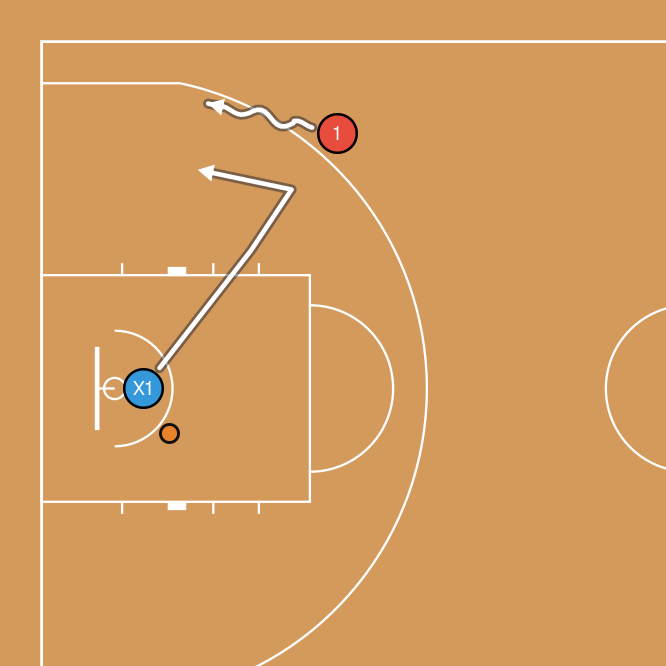
The on-ball defender plays about an arm's length away, low and balanced, and keeps the ball in front instead of gambling for steals. With four teammates packed behind, the job is to stop straight-line drives, contest every shot and steer any dribble toward the nearest help.
- 2
Stay inside the pack line
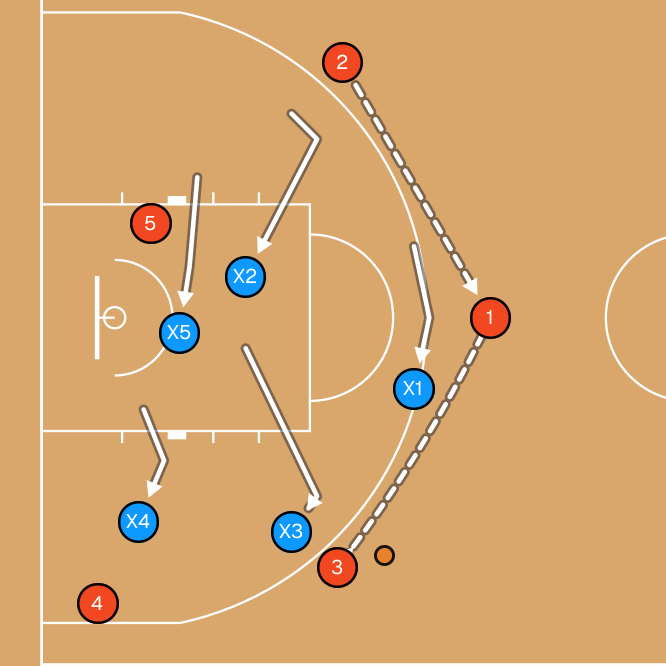
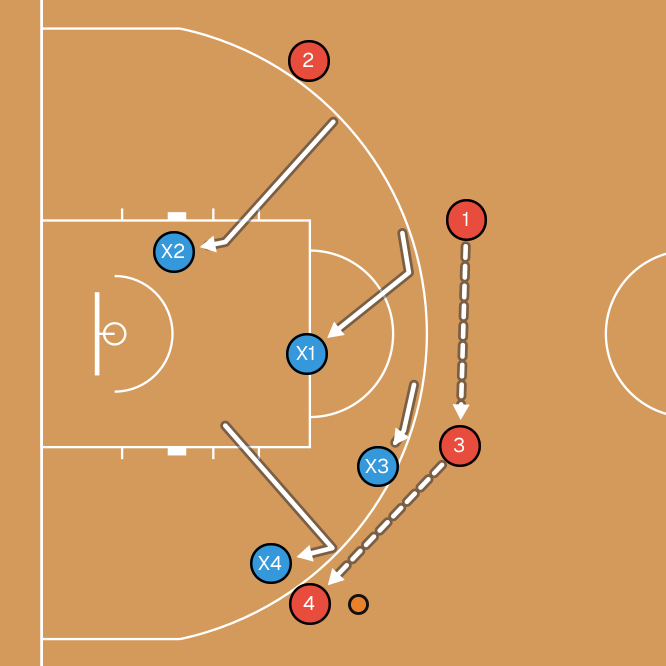
All four off-ball defenders stay on or inside the pack line, about 16 feet from the rim and a few feet inside a high school three-point arc. Each one sits in a gap between two attackers, pointing at ball and player. Defenders one pass away do not deny; they concede the perimeter catch and stay close enough to stop the drive. An NBA pack line must still respect defensive three seconds (Rule 10, Section VII); US high school and youth games have no such rule.
- 3
Help in the gaps
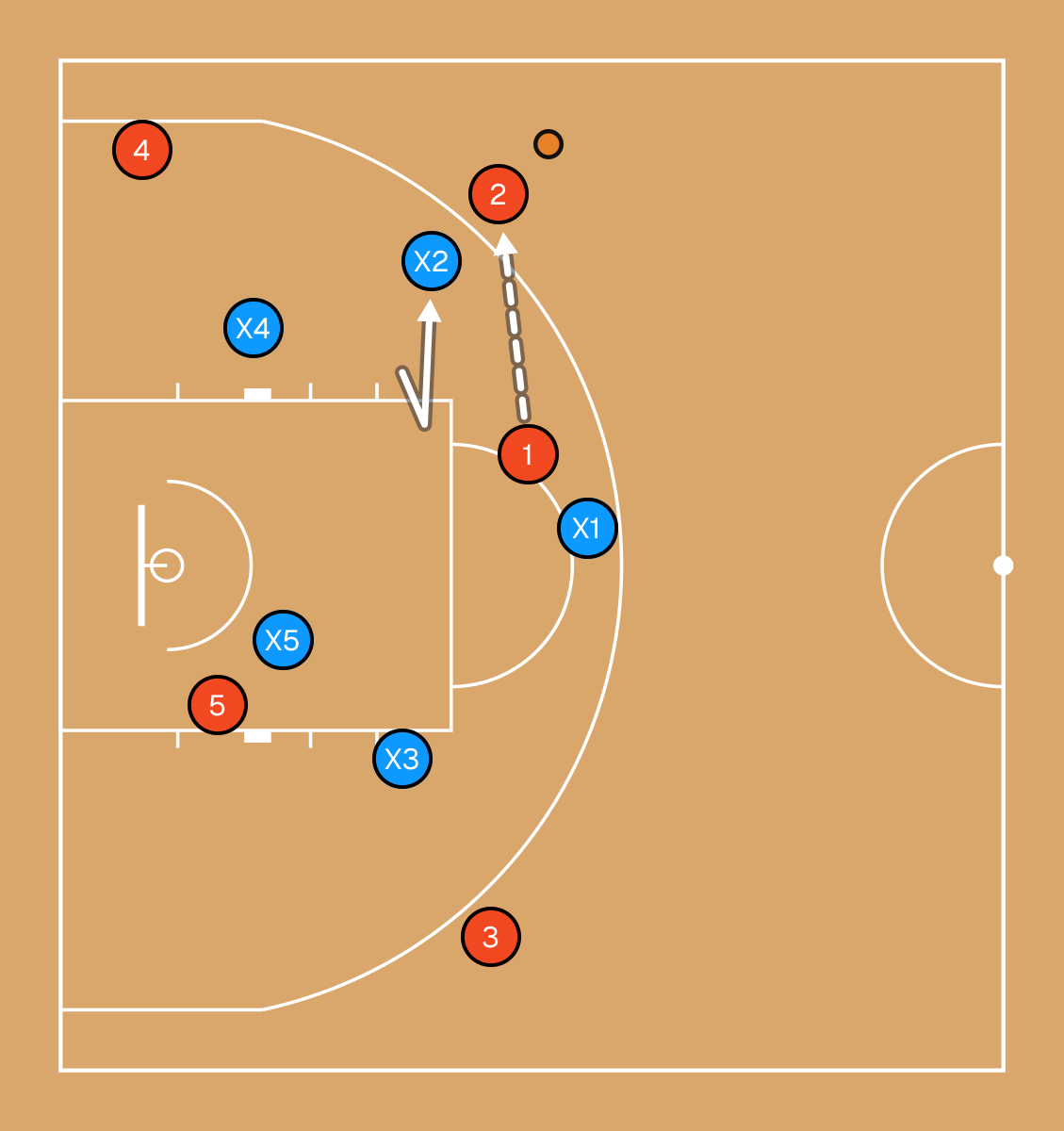
When 1 drives the right gap from the top, the two nearest defenders, X2 from the wing side and X5 from the lane, step into the path and show a wall of two bodies, chests square and hands straight up. X1 stays on the hip and keeps pressure from behind. Nobody leaves the line early to chase a deflection; gap help only works when it is already there.
- 4
Close out from the pack
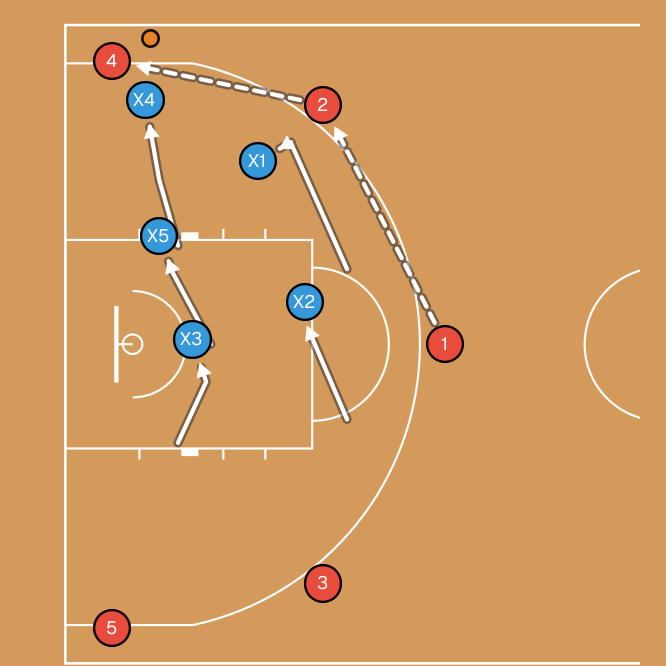
When 1 kicks the ball out to 2 on the right wing, X2 closes out from the pack while X5 drops back into the lane. The first steps are a sprint; the last two or three are short, choppy steps with the weight back, a high hand at the shooting hand and the feet set to keep the ball out of the middle. A closeout that flies past the shooter undoes the whole defense.
- 5
Rebound as a pack
On the shot, all five turn, find the nearest attacker and make contact before chasing the ball. The pack is already between the shooters and the rim, so the box-outs are short and the defense has inside position on most misses. The closeout defender stays on the shooter, because long rebounds off a three often come back toward the perimeter.
| Question | Pressure man-to-man | Pack line |
|---|---|---|
| Where off-ball defenders stand | One pass away in the passing lane, denying the catch | On or inside the 16-foot pack line, in a gap |
| Main goal | Force turnovers and push catches farther from the basket | Keep the ball out of the paint and force contested jump shots |
| Best against | Shaky ball handlers and teams that rely on rhythm passing | Driving teams and teams that score in the paint |
| Biggest risk | Backdoor cuts and drives past overplaying defenders | Open threes after slow closeouts against strong shooting teams |
| Who it suits | Quick, athletic, deep rosters | Disciplined teams without elite athletes |
| Typical result | More turnovers and more fouls at a faster pace | Fewer layups and fouls, longer possessions, more jump shots |
Coaching points
Contest every shot with a high, straight hand and without jumping into the shooter; the pack line wins by forcing hard shots without sending anyone to the line.
Talk from the pack with "ball", "gap", "help" and the cutter's name, so the on-ball defender knows the wall is there.
Shift inside the line on the flight of every pass, so the gaps are filled again before the catch.
Bump cutters off their path through the lane; the pack puts a body in every cut instead of trailing it.
Mark the 16-foot arc with tape in practice until players can find it without looking down.
Variations
Pack line with ball-screen ICE
On side ball screens, the guard jumps above the screen and forces the handler toward the sideline and baseline while the big drops below the screen to contain. The pack behind helps on the roll, so the ball never gets back to the middle of the floor.
Extend to pressure late in games
When you are behind late, step out of the pack and deny one pass away, trap the ball handler or pick up higher on the floor. The switch to pressure man-to-man creates the turnovers you need and looks like a new defense to an opponent that has spent the game passing around the pack.
Build it in Coach Board
Players learn how far to sink once they can see the line they defend from. On a half-court board in Coach Board, draw the 16-foot arc as a zone, place 1 at the top with the four off-ball defenders inside it, then animate the drive into the right gap, the two-player wall, the kick-out to 2 and X2's closeout as separate steps. Loop it and share the link so every player sees their spot on the line before practice.
Drawing your own plays? Use the basketball play maker.
Start 7-day free trial →No card required
Questions coaches ask
What is the pack line defense in basketball?
The pack line defense in basketball is a sagging man-to-man in which the on-ball defender pressures and the other four stay inside an imaginary line about 16 feet from the basket. They help in the gaps instead of denying passes, so every drive meets a crowd, and they close out under control on each kick-out to contest the shot.
How do you beat the pack line defense?
Beat the pack line defense by making shots and moving the ball faster than the pack can shift. Reverse the ball and skip it across the floor to force long closeouts, then drive the closeout and kick to the next shooter. High-low passes, hard basket cuts and patience for a late-clock look also stretch a defense that wants to stay packed in.
Is the pack line good for youth or high school teams?
The pack line suits high school teams without elite athletes, because it protects the paint and keeps players out of foul trouble, but it demands discipline on every closeout. Youth players should learn basic man-to-man first, including stance, help and recover, and add the pack line only once those habits are automatic in live play.