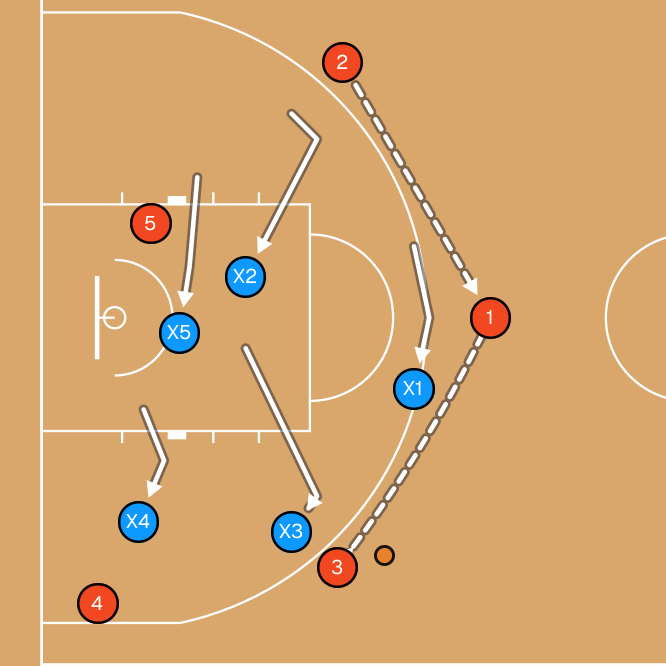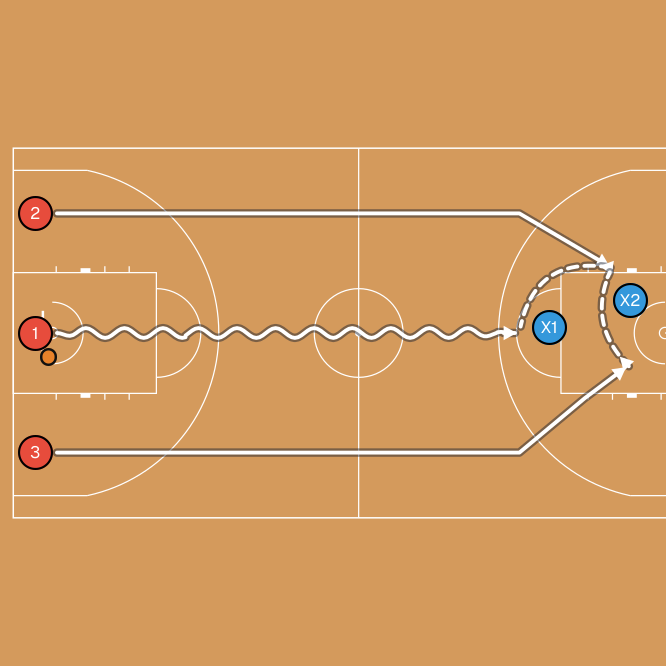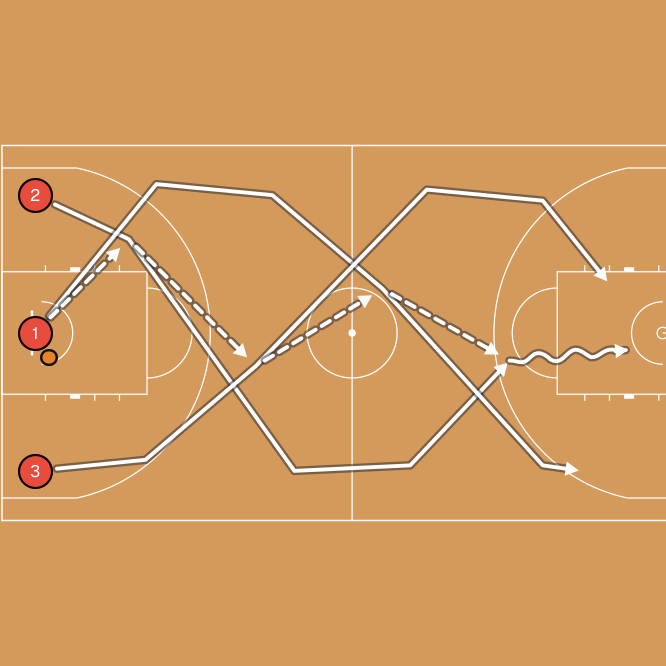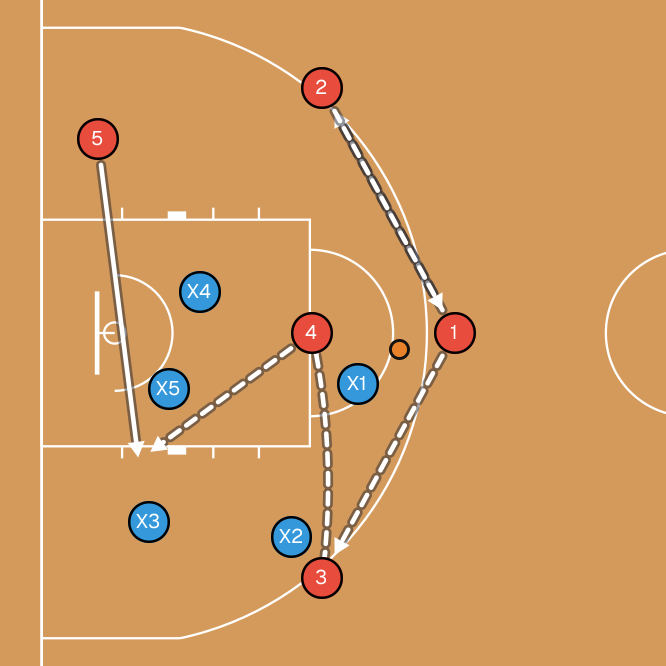




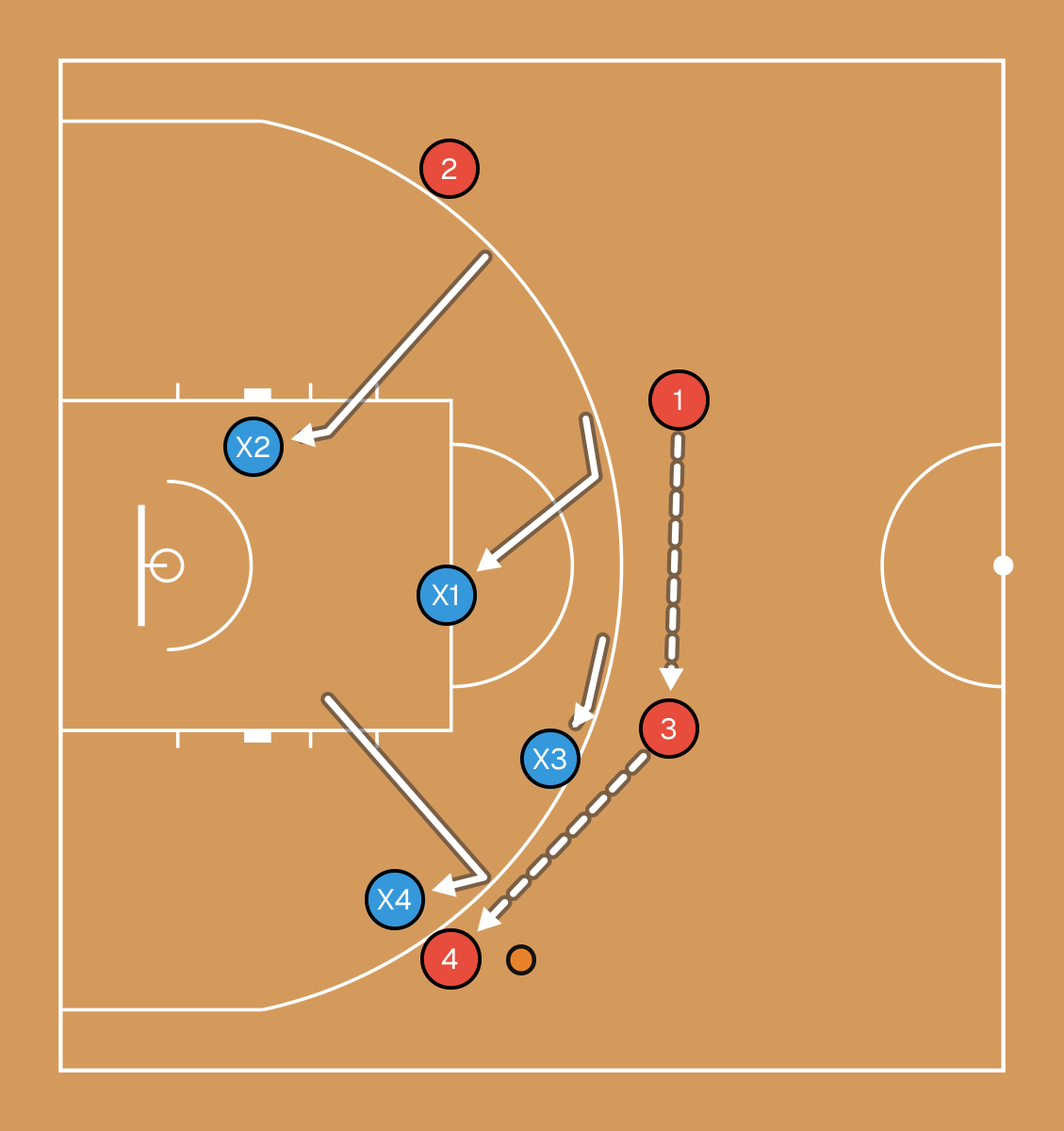
The shell drill is the oldest teaching tool in team defense for a reason: four offensive players space the perimeter, four defenders match up, and every pass forces the defense to re-position. Each defender is either pressuring the ball, denying one pass away, or sagging to the help line two passes away. It strips defense down to positioning before speed, which is why programs at every level still open defensive practice with it.
The drill's power is in its progressions. It starts with the offense standing still and passing on the coach's whistle, so defenders can be frozen and corrected, and it ends fully live with drives, closeouts and x-out rotations. A team that has honestly graduated through every shell phase rarely gets beaten by simple ball movement.
Objective
Train all four off-ball defensive positions (pressure, deny, and help-side) until players re-position automatically on every pass and drive.
Setup
- Area
- Half court
- Players
- 8 (4v4); rotate a third group of 4 in every few minutes
- Equipment
- 1 ball, coach's whistle
- Duration
- 10–20 minutes
How it works
- 1
Phase 1: Positioning on the pass
Offense spaces at both slots and both wings and passes only when the coach calls it. On each catch, the on-ball defender pressures, defenders one pass away deny with a hand in the passing lane, and defenders two passes away drop to the help line with a ball-you-man triangle. Freeze after each pass and fix feet.
- 2
Phase 2: Jump to the ball
Same setup, but now the passes come in rhythm. Every defender must move while the ball is in the air, not after the catch. The guard guarding the passer jumps toward the ball to prevent the give-and-go face cut.
- 3
Phase 3: Add the drive
On the coach's call, the ball handler attacks a gap. The nearest help defender stops the ball at the lane line, the weak-side low defender rotates across, and everyone else sinks. Kick-out passes trigger sprint closeouts with high hands and choppy steps.
- 4
Phase 4: X-out rotations
When help comes from the weak-side corner defender, the drill teaches the x-out: the helper takes the drive, and the next defender rotates behind him to the open corner shooter, crossing paths underneath. No ball-watching, no doubling one man.
- 5
Phase 5: Live to a stop
Play 4v4 fully live with a rule: the defense must get three consecutive stops to rotate off. Cutters, skip passes and drives are all allowed, so every habit from phases 1–4 gets tested under fatigue.
Coaching points
Help-side defenders keep one foot in the lane and both the ball and their man in view; if they can't see both, the triangle is broken.
Move on the flight of the ball. A defender who waits for the catch is already a full step behind the rotation.
Closeouts finish short and choppy with the high hand matching the shooter's release side. Flying past a pump fake undoes the whole possession.
Talk is part of the drill: 'ball', 'deny', 'help', and 'shot' calls should be loud enough to hear from the far baseline.
Variations
Shell with cutters
After each pass, the passer face-cuts to the rim and fills the weak corner. Defenders must jump to the ball, deny the cut, then recover to new help positions as the offense re-spaces.
Disadvantage shell
Play 5v4: the defense is always one rotation short, so every drive forces a full x-out and a scramble back. Brutal, but it makes standard 4v4 rotations feel slow-motion by comparison.
Build it in Coach Board
Recreate each shell phase on a Coach Board half court and animate the four defenders' slides on every pass, one animation per pass around the perimeter. Pause the playback mid-flight to show exactly where the help line is while the ball is still in the air, then share the clip so players review positions before practice.
Setting up your own drills? Use the coach whiteboard.
Start 7-day free trial →No card required
Questions coaches ask
What does the shell drill teach?
Shell teaches off-ball defensive positioning: pressuring the ball, denying the pass one away, and sinking to help-side two passes away. Later phases add jump-to-the-ball habits, gap help against drives, closeouts and x-out rotations, so it covers nearly every non-rebounding piece of half-court defense.
How long should shell drill run in practice?
Ten to fifteen focused minutes is plenty. Shell is a precision drill, not a conditioning drill. Once stances and rotations get sloppy from fatigue, players rehearse mistakes. Many coaches run a short shell block every day instead of one long block weekly.