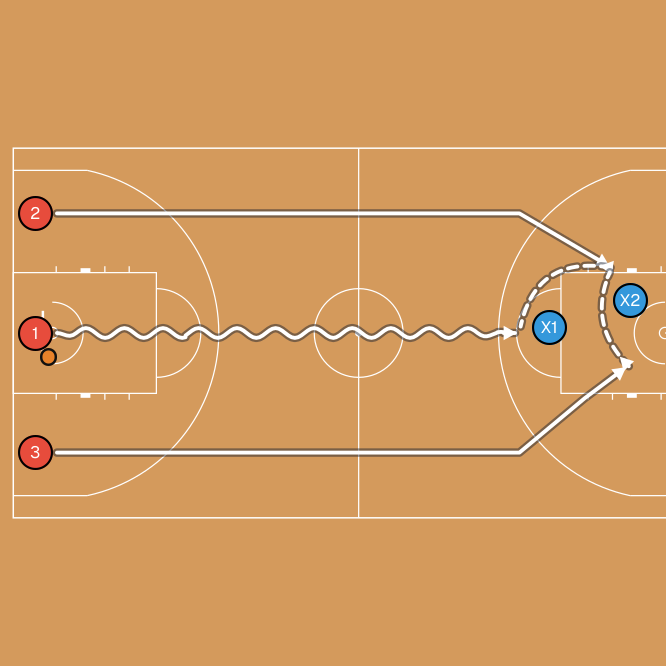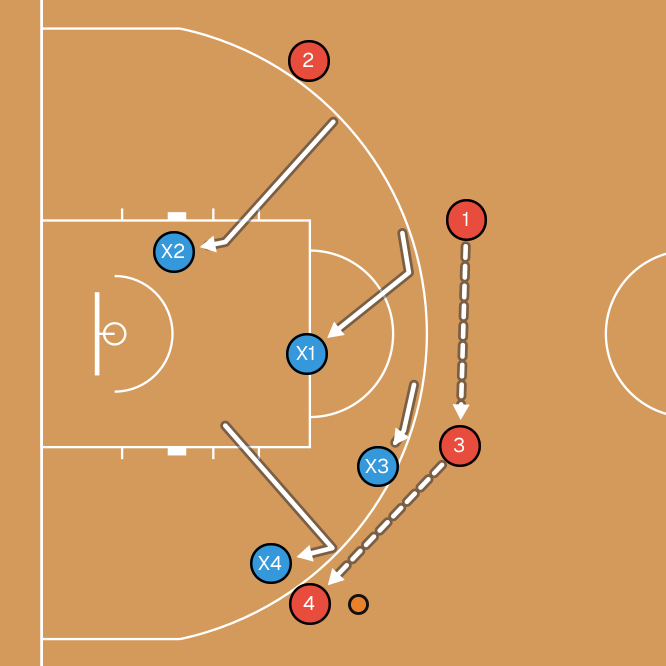



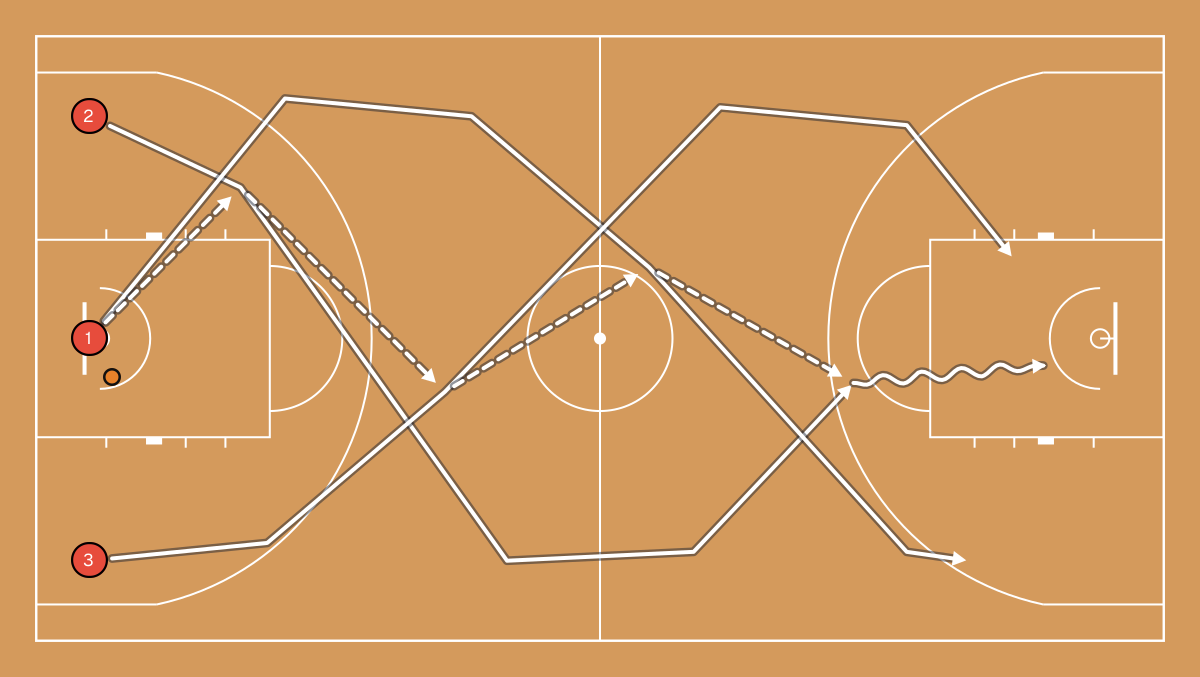
Three lines on the baseline, one ball in the middle, and a simple rule (pass and run behind two) send three players weaving the length of the floor toward a layup at the far end. The 3-man weave has opened practices for generations because it packs sprinting, on-the-move catching and unselfish timing into thirty seconds per group, with zero setup.
It gets dismissed as a relic by some coaches, and badly run it deserves that: a jogged weave with lobbed passes trains nothing. Run at genuine game pace, with passes leading the receiver and finishes counted aloud, it remains one of the most efficient ways to warm up hands, legs and communication at once, and its progressions turn it into a real transition teaching tool.
Objective
Warm up full-court passing, catching on the move and lane spacing at game speed, finishing every trip with an untouched-dribble layup.
Setup
- Area
- Full court
- Players
- 3 per group, 9–15 total for continuous rotation
- Equipment
- 1 ball per group of three
- Duration
- 6–10 minutes
How it works
- 1
Start the pattern
Three players line up across the baseline: one under the basket with the ball, one at each free-throw-line-extended sideline area. On 'go', the middle player passes to either side and sprints behind the receiver, replacing him wide.
- 2
Weave the floor
The receiver takes the catch toward the middle and delivers to the third player crossing from the far side, then runs behind him in turn. The rule that keeps the braid alive: pass, then run behind two, always ending up in the outside lane opposite where you started.
- 3
Time the finish
Around the far free-throw line, the player catching in the middle attacks the rim for a layup off one dribble at most, ideally none. The two teammates fill the lanes: one crashes for the rebound before the ball hits the floor, the other spaces to the outlet area.
- 4
Return trip
The rebounder outlets immediately and the group weaves back the other way for a second layup, then jogs off as the next three step on. No walking the ball back: the return trip is where conditioning quietly happens.
- 5
Score it
Set a team target: for example 20 made layups in three minutes with zero dropped passes, counted aloud by everyone waiting. A missed layup or fumbled catch resets the count to keep the pace honest under pressure.
Coaching points
Passes are crisp and chest-high, leading the receiver into space. A weave run with rainbow lobs is a weave wasted.
Sprint wide before cutting in; groups that pinch toward the middle turn the braid into a traffic jam by half court.
Catch with feet ready so no travel sneaks in. The weave is where sloppy footwork habits get grooved or fixed.
Finish every rep: lay the ball up softly off the glass at full speed. Missed layups in warm-ups become missed layups in games.
Call names before every pass. The weave is a communication drill wearing a conditioning costume.
Variations
Weave into 2v1
After the first layup, the shooter retreats as the lone defender while the other two attack back the other way 2v1, instantly converting the warm-up into live decision-making.
5-man weave
Five players, same rule but run behind three. The wider braid demands longer passes and sharper timing, and suits older teams that have outgrown the three-lane version.
Build it in Coach Board
The weave is the drill players always claim to know and then tangle up, so animate the braid in Coach Board with all three running paths drawn in different colors on a full-court board. Press play and let the loop run on the gym tablet while groups wait their turn. The crossing pattern explains itself in motion far better than three arrows on a whiteboard ever did.
Setting up your own drills? Use the coach whiteboard.
Start 7-day free trial →No card required
Questions coaches ask
What does the 3-man weave teach?
Passing and catching on the move at full speed, lane spacing in transition, and communication. Its hidden value is rhythm: three players must time their cuts off each other's passes, which is the same coordination transition offense demands. It also doubles as a conditioning warm-up.
How do you stop players tangling up in the weave?
Teach the single rule 'pass, then run behind two players' and walk the first reps at half speed. Nearly every tangle comes from a passer cutting in front of the receiver instead of behind, or from players hugging the middle. Insist on sprinting wide to the sideline before cutting back in.