



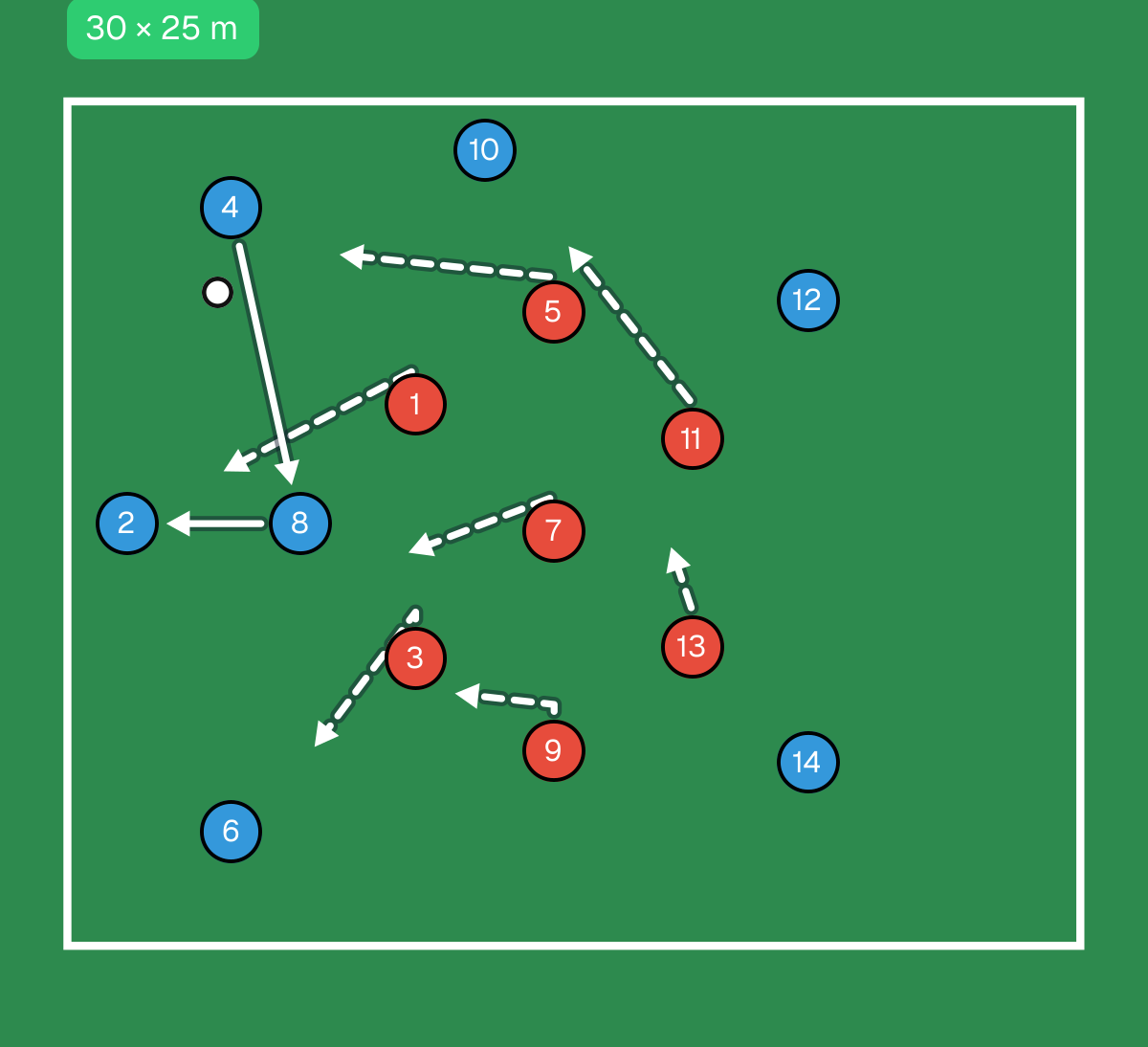
Pressing fails far more often from bad timing than from a lack of running. Eleven players sprinting at random get played through; eleven players who recognize the same cue and go together suffocate opponents. Those cues are pressing triggers: a back-pass, a bouncing ball, a heavy touch, a pass to a receiver facing his own goal or pinned against the touchline.
Elite pressing sides codify these moments explicitly: Guardiola's and Klopp's teams are drilled on precisely which pictures release the hunt. This exercise gives your squad the same shared vocabulary by embedding named triggers into a possession game, so recognition is trained on live, messy pictures rather than on a whiteboard.
Objective
Train the whole out-of-possession unit to recognize shared pressing cues and convert them into a coordinated six-second hunt, while staying compact and patient between triggers.
Setup
- Area
- 30x25m grid divided by a halfway line of cones
- Players
- 14: two teams of seven (or 6v6 plus two neutrals with smaller squads)
- Equipment
- Cones for the grid and halfway line, 2 sets of bibs, Plenty of spare balls, 2 mini goals for the progression
- Duration
- 15–20 minutes
How it works
- 1
Start in a contained block
Play 7v7 possession in the 30x25m grid, split into two halves. The out-of-possession team may initially only press inside its own half. In the far half they must hold a compact block, shuffling with the ball but not engaging.
- 2
Name the triggers
Announce three triggers that release a full-grid press: a back-pass, a first touch that runs away from a player, and any pass to a teammate standing within 2m of the boundary. From now on, spotting one of these frees the whole team to hunt anywhere.
- 3
Score the reaction
A regain within six seconds of a trigger is worth two points; a regain at any other moment is worth one. The possession team banks a point for every twelve completed passes. The scoring gap is what teaches players to wait for the right moment.
- 4
Freeze the missed moments
When a clear trigger goes unpunished, freeze play and ask the pressing team who saw it. Early rounds produce plenty of these conversations. That is the recognition work happening.
- 5
Make it directional
Add two mini goals per end. After a triggered regain, the winning team has eight seconds to score, tying the pressing habit to its match reward and adding a transition to defend for the other side.
Coaching points
The first presser bends his run so his cover shadow blocks the simplest outlet while he attacks the ball: one run, two problems solved.
When a pass travels to a receiver facing his own goal, press his blind-side shoulder so his only comfortable options are backwards or out of play.
The trigger belongs to everyone: midfielders and the back players must step up in the same instant, squeezing the grid so there is no quiet space to escape into.
Agree one short call any player can shout when he spots the cue, so the press launches on sound as well as sight.
Variations
Secret trigger
Privately give the pressing team one additional trigger the possession side does not know about. Watching the press detonate 'for no reason' forces the possession team to scan for what changed, and doubles the recognition work.
Touchline trap
Mark 5m-wide trap zones along both sidelines. Any ball entering a trap is an automatic trigger, teaching the classic scheme of showing opponents wide and springing when the line becomes a second defender.
Build it in Coach Board
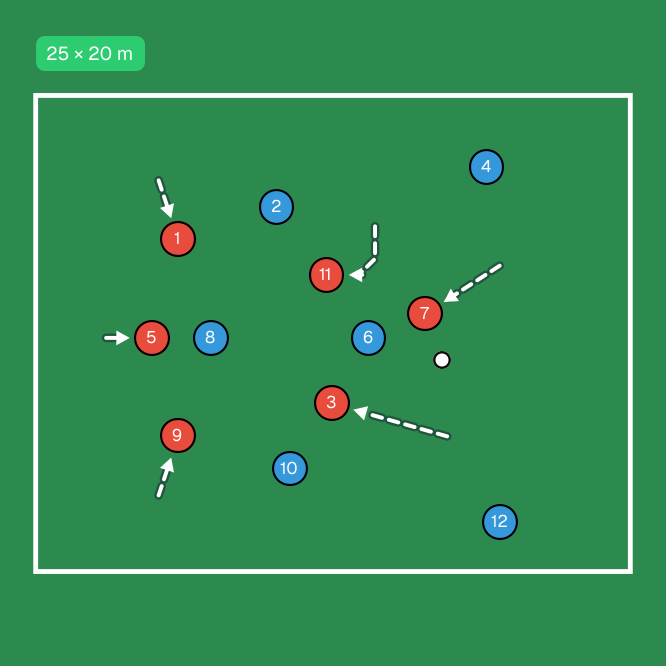
Shade the trap zones on a Coach Board pitch, then build a two-frame animation: frame one shows the block shuffling passively as the ball circulates, frame two erupts on the back-pass with every pressing arrow firing at once. The visual contrast between waiting and hunting is the entire lesson.
Setting up your own drills? Use the football session planner.
Start 7-day free trial →No card required
Questions coaches ask
What are the most common pressing triggers?
The back-pass, a poor or bouncing first touch, a pass to a receiver with his back to play, a slow pass across the back line, and any receipt close to the touchline. Most teams pick two or three to drill deeply rather than overloading players with a long list.
What is the difference between a pressing trigger and a pressing scheme?
The scheme is the standing structure: who marks whom, which zones are shown, where the trap is set. The trigger is the momentary cue that releases that structure into an active hunt. A team needs both: schemes without triggers never spring, and triggers without schemes spring into chaos.