



Defending one-against-one is a craft with its own grammar (approach speed, body angle, distance, patience), yet most players are only ever told to "win your duel". This channel drill isolates the moment a defender steps out to an attacker in space and teaches each element of it deliberately.
The modern game makes the work urgent. High lines and wide-open transitions leave full-backs and center-backs exposed in acres of grass far more often than a low-block era ever did, and a defender who dives in from five meters is a defender already beaten.
The serve-and-press start is the detail that separates this from generic duelling. Because the defender plays the opening pass himself, he rehearses the real match sequence dozens of times per session: release the ball, sprint out while it travels, decelerate into a controllable position.
Objective
Build the full 1v1 defending sequence: closing the gap while the ball travels, arriving under control, jockeying side-on to steer the attacker, and timing the tackle off a heavy touch.
Setup
- Area
- A 12x10m channel per pair, end lines marked clearly
- Players
- Pairs (one attacker, one defender), several channels running at once
- Equipment
- Cones for each channel, 1 ball per pair, Bibs to split attackers from defenders when rotating
- Duration
- 12–15 minutes
How it works
- 1
Mark the duelling channel
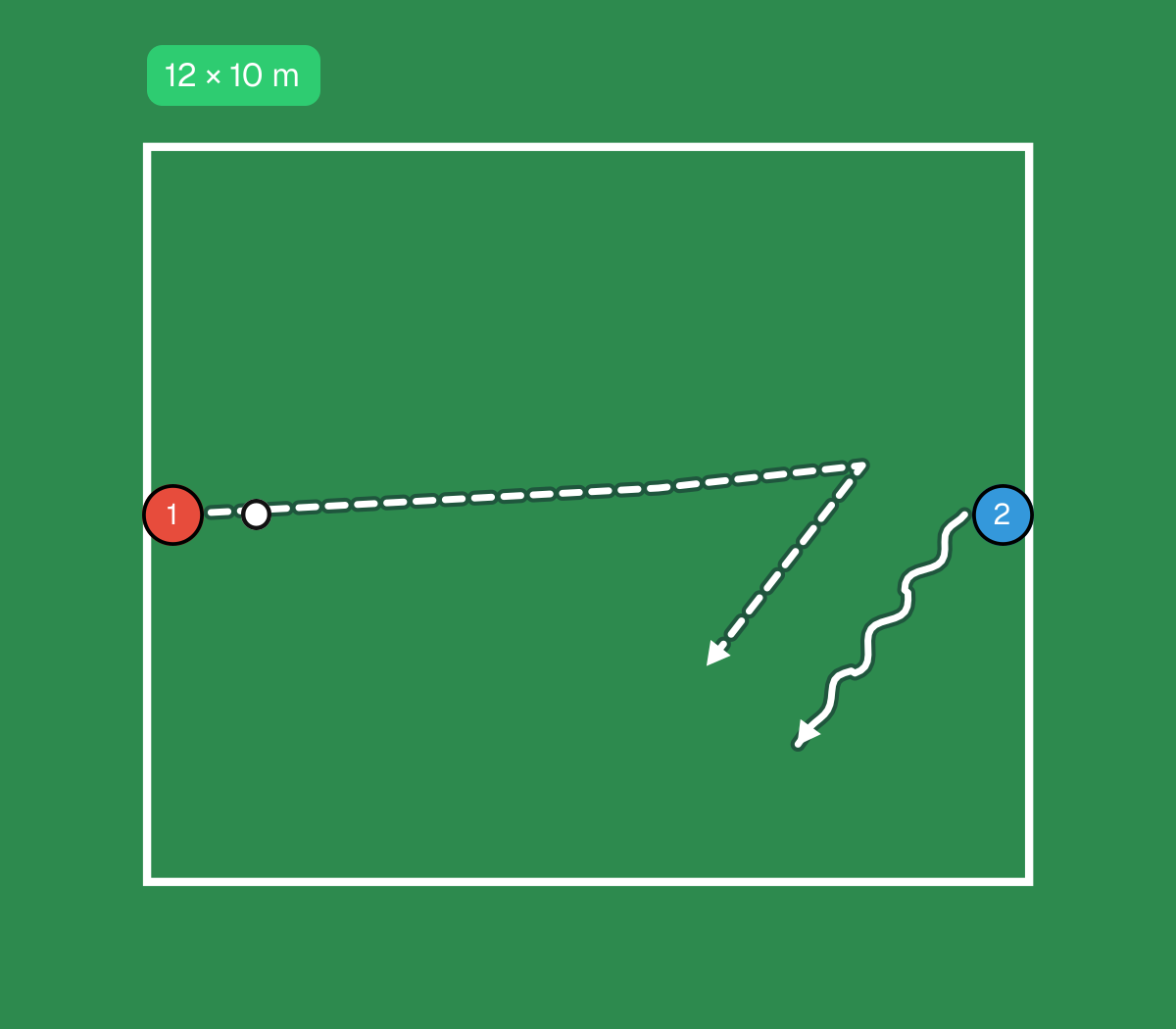
Each pair gets a 12m-long, 10m-wide channel. The attacker stands on one end line, the defender on the other with the ball at his feet. The attacker's target is to dribble over the defender's end line under control.
- 2
Serve and close
The defender starts every repetition by passing firmly across to the attacker, then sprints forward while the ball travels. The flight of his own pass is his window to eat up ground for free.
- 3
Decelerate into the duel
Two meters out, the defender chops his stride into short stutter steps and settles side-on, roughly an arm's length away. Arriving flat-out and square is the classic error this step exists to kill.
- 4
Play the duel to a finish
The attacker may feint, change pace and attack either side. The defender scores by winning the ball and carrying it back over his own line; the attacker scores by crossing the far line with the ball. Play best-of-five, then swap roles.
- 5
Rotate opponents
After each best-of-five, attackers move one channel to the left so everyone faces different feints, speeds and body types. Duels against a single familiar partner teach less than they seem to.
Coaching points
Close while the ball travels, not after it arrives. The serve is your pressing trigger and your head start.
Slow down early: short choppy steps in the final two meters keep your hips free to react to the first feint.
Set your body side-on with knees bent and weight on the balls of the feet, showing the attacker down one side only.
Steer him onto his weaker foot or toward the channel's edge, then squeeze the space stride by stride.
Watch the ball, not the shoulders or the stepovers, and strike the tackle only when a touch goes heavy.
Variations
Angled serve
The defender serves diagonally to an attacker positioned in the channel's corner, forcing a curved, angled approach run and a duel along the line: the full-back's daily reality.
Delayed second defender
Turn it into 1v1+1: a recovery defender enters three seconds late. The first defender now defends to delay rather than to win, holding the attacker up until help arrives.
Build it in Coach Board
Draw the 12x10m channel in Coach Board and animate the defender's repetition frame by frame: the serve, the sprint that slows into stutter steps, the side-on set position. Add short text labels on each beat like "close while it travels" and "slow-slow-sideways". Looping that clip at walk-through pace shows young defenders the rhythm words alone never convey.
Setting up your own drills? Use the football session planner.
Start 7-day free trial →No card required
Questions coaches ask
How do I teach a player to jockey properly?
Have them defend side-on at an arm's length, knees bent, moving with short lateral steps and never crossing their feet. The goal of jockeying is not to win the ball but to slow the attacker, steer him one way and wait for a mistake worth pouncing on.
When should a defender actually tackle in a 1v1?
Only when the odds flip: a heavy touch, the attacker's head going down, or the ball caught on his weaker side. Until one of those happens, patience and position are worth more than any lunge, because a missed tackle removes the defender from the play entirely.