


Motion offense in basketball is a read-and-react system where five players share a few rules: space the floor, pass and cut, go backdoor when denied, screen away and read the ball screen. Coaches at every level use it against man-to-man defense, because each rule turns a defender's denial or help into an open cut or shot.
Man-to-man defenders are taught to deny passing lanes and sink to help on drives. Motion punishes both habits. The defender who overplays the wing gives up the backdoor, the helper who leaves his man gives up the kick-out, and nobody can scout the next action because the offense has not decided it yet. That makes motion the standard answer when a coach asks how to beat man-to-man without a thick playbook, whether the team runs four out with a post or five out with an empty lane.
Objective
Create layups and open catch-and-shoot chances against man-to-man by teaching five rules every player can read, so the offense reacts to the defense instead of a script.
Setup
- Area
- Half court
- Players
- 5 offensive players; start 5v0 to learn the rules, then 5v5 against man-to-man
- Equipment
- 1 ball, Cones for the top, wing and corner spots
- Duration
- 15–20 minutes per practice, one new rule a week
How it works
- 1
Space the floor
Pick a 4-out 1-in or a 5-out shape and set the spots 15 to 18 feet apart. In the 4-out version, 1 brings the ball to the top, 2 and 3 take the right and left wings, 4 sits in a corner and 5 posts on the block. Spacing is the rule that makes the others work: one defender should never be able to guard two players.
- 2
Pass and cut
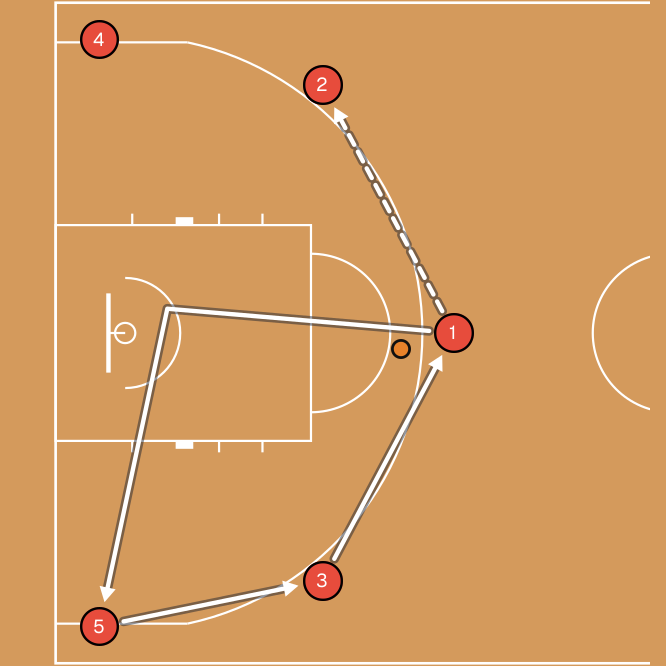
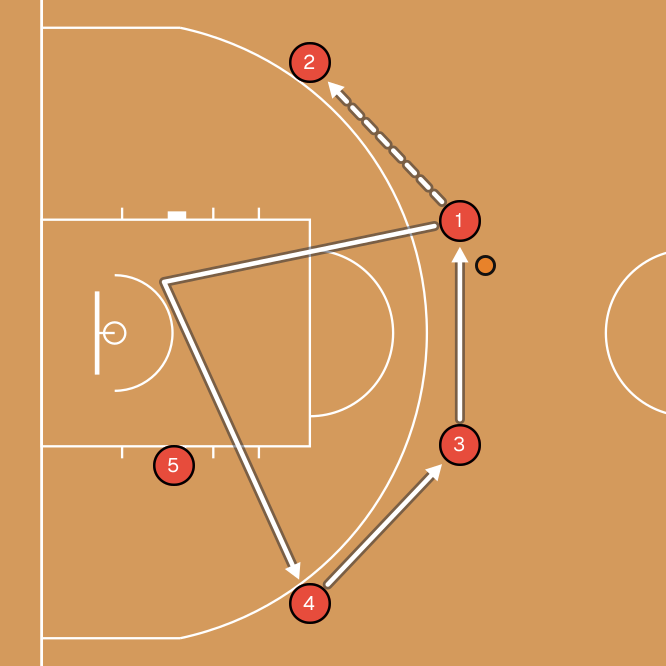
After every pass, the passer moves. The first option is a hard give-and-go cut to the rim, front cut if his defender stays home and back cut if the defender jumps toward the ball. If the return pass does not come, he exits to an open spot and the nearest teammate fills the one he left.
- 3
Go backdoor when denied
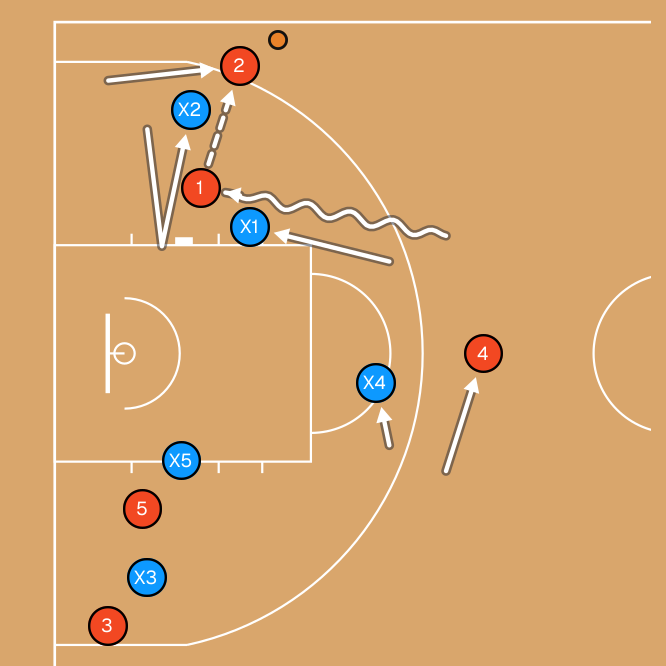
When a defender puts a hand and foot in the passing lane, the receiver takes one step out, plants his outside foot and cuts behind the defender to the basket. The ball handler throws a bounce pass. Denial is the core habit of man-to-man defense, so this cut is your most reliable layup against it.
- 4
Screen away
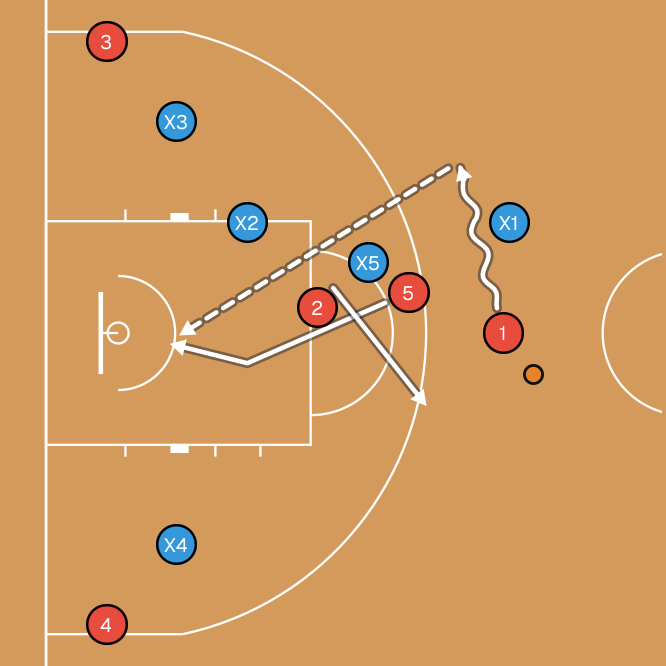
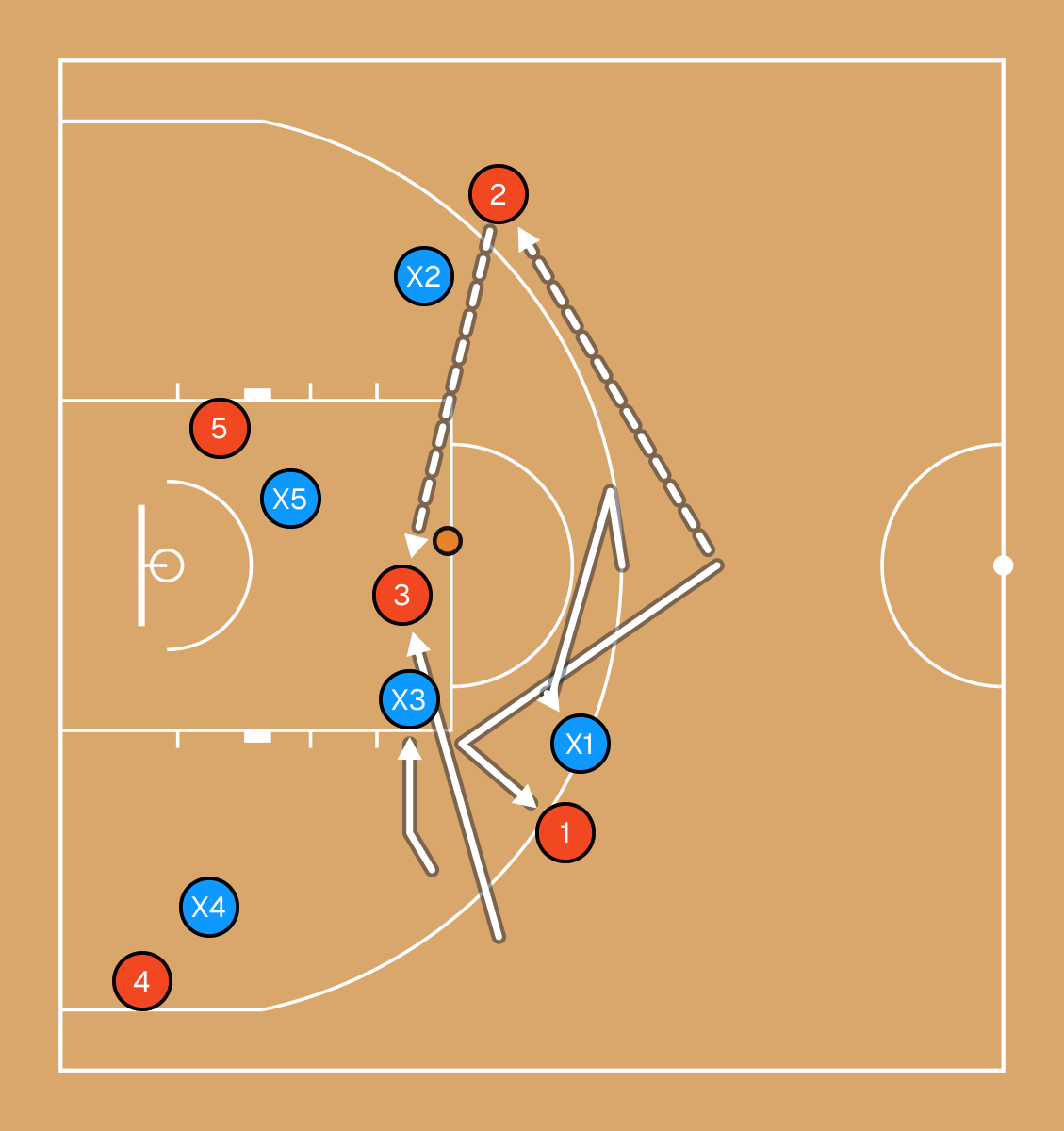
Instead of cutting, the passer screens for a teammate on the far side. 1 passes to 2 on the right wing and screens away for 3. The cutter reads his defender: trailing means curl tight into the lane, cheating over the top means a straight cut to the rim, sagging under means flare or pop out for a shot. Here 3 curls into the lane and 2 hits him.
- 5
Read the ball screen
5 sets a ball screen for 1 at the top, and 1 reads the big defender. If X5 hedges high, 1 passes to 5 rolling to the basket. Against a drop, 1 pulls up or 5 pops; against a switch, attack the mismatch; against ice, reject the screen or have 5 re-screen at a better angle.

In this play
Motion offense: read the hedge, hit the roller
A ball-screen read inside the motion offense: 5 comes up to screen for 1 at the top, X5 hedges high, so 5 rolls to the rim and 1 passes to 5 rolling.
- The floor is spaced with 1 at the top and 5 on the right block.
- 5 comes up to set a ball screen for 1.
- 1 uses the screen to the right, and X5 hedges high to stop him.
- 5 rolls to the rim behind the hedge.
- 1 passes to 5 rolling.
| System | Spacing | Best for | Main action | Article |
|---|---|---|---|---|
| 5-out motion | All five outside the arc | Teams without a post, young teams | Pass, cut, fill and backdoor | 5 Out Motion Offense |
| 4-out 1-in motion | Four outside, one post inside | Teams with one inside scorer | Pass and cut, screen away, post flash | 4 Out 1 In Motion Offense |
| Dribble drive motion | Four out, post on the weak-side block | Quick guards who beat defenders off the dribble | Drive the gap, kick out or dump off | Dribble Drive Offense |
| Flex offense | Two slots, two corners, one block | Teams that want a set pattern | Flex screen and down screen continuity | Flex Offense |
| Princeton offense | Four out, center at the high post | Patient teams with a passing big | High-post entry and backdoor cuts | Princeton Offense |
Coaching points
Cut with a change of pace: walk your defender a step one way, then explode the other way.
Every catch faces the rim in triple threat, because a receiver who can shoot forces a real closeout.
Hold a screen until the cutter brushes your shoulder; leaving early lets his defender run straight through.
Read the defender, not the teammate: the cut you choose comes from where your own man is standing.
Keep one player above the top of the key on every shot to stop the fast break.
Variations
Teach it without screens first
For the first two weeks, allow only pass, cut and fill, with no screens at all. Players learn spacing and timing without bodies in the way, and coaches can see at once who stands still after passing. Add screen away only when the cutting looks automatic in 5v5.
Add a ball screen series
Once off-ball screening is sharp, allow any player to call for a ball screen at the top or on a wing. Start with one coverage in practice, such as the hedge, so the ball handler learns to find the roller, then mix in drop and switch so players practice choosing.
Shot-clock rule: a paint touch before a three
In scrimmages, a three counts only after the ball has touched the paint by a drive, a post entry or a cutter's catch. The rule stops quick perimeter jumpers and forces the defense to collapse before the kick-out, which is where the best threes come from.
Build it in Coach Board
Players read man-to-man faster when they have seen each trigger before they meet it on the court. Place your five players and the defenders on a Coach Board court, animate one board per rule step by step, and duplicate it to show the curl, straight cut and flare from the same screen. Loop the backdoor and the ball-screen reads, file them in one playbook folder and share the link so players review them on a phone or iPad before practice.
Drawing your own plays? Use the basketball play maker.
Start 7-day free trial →No card required
Questions coaches ask
How do you beat a man-to-man defense in basketball?
Beat a man-to-man defense with spacing and movement. Keep players 15 to 18 feet apart, cut after every pass, go backdoor when a defender denies, and screen away so defenders must fight through contact. A ball screen forces two defenders to guard the ball. Pick-and-roll ball handlers finished over 17% of NBA possessions in 2021-22, according to Synergy data on NBA.com.
What are the rules of motion offense?
The basic rules of motion offense are to keep the floor spaced, cut after you pass, cut backdoor when your defender denies you, screen away from the ball and read every ball screen. Teammates refill open spots so the spacing returns after each cut. Most coaches add one rule per week, starting with pass and cut.
Is motion offense good for youth basketball?
Yes, motion offense suits youth basketball well. NBA and USA Basketball youth guidelines recommend no zone defense for ages 7 to 11, so young teams mostly face man-to-man, and motion teaches them to read it. Every player handles, cuts and screens instead of memorizing one spot, which builds skills they keep at any level.