


A matchup zone defense, also written match up zone, blends man-to-man and zone. The defender on the ball guards tight man-to-man, the other four guard zone areas, and when an attacker cuts through, their defender hands them to the next teammate instead of chasing. Coaches use it to look like man on the ball while keeping zone help in the lane.
Because the shape bends to the offense, the usual zone gaps close early, and the same habits let you change between man and zone on one call. In the 2019-20 NBA season, teams used zone on about five possessions a game, and offenses scored 0.99 points per possession against zone and 0.96 against man (Synergy data via NBA.com). That is NBA data, not high school: zone there is a change of pace, not a base defense.
Objective
Show a man-to-man look on the ball with zone help behind it, and switch between man and zone on one call.
Setup
- Area
- Half court
- Players
- 5 defenders vs 5 attackers in a 1-3-1 set
- Equipment
- 1 ball, bibs, cones at the five 2-3 zone spots
- Duration
- 20–25 minutes
How it works
- 1
Match the offense's set
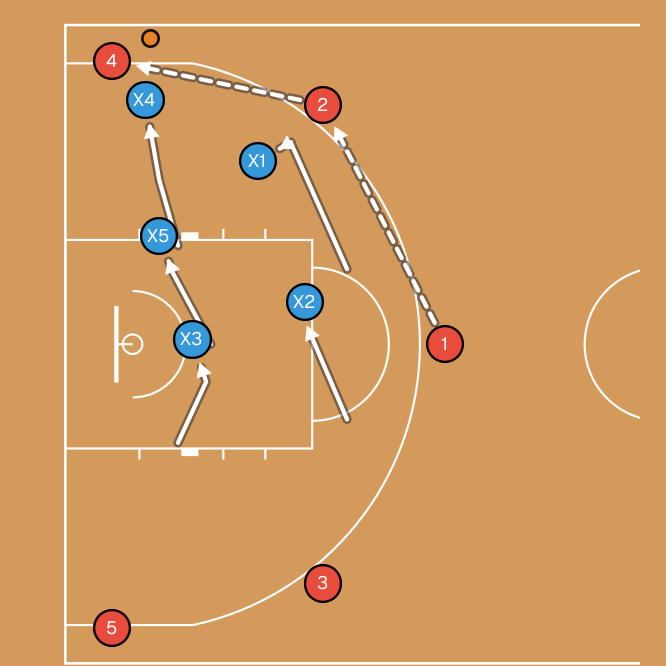
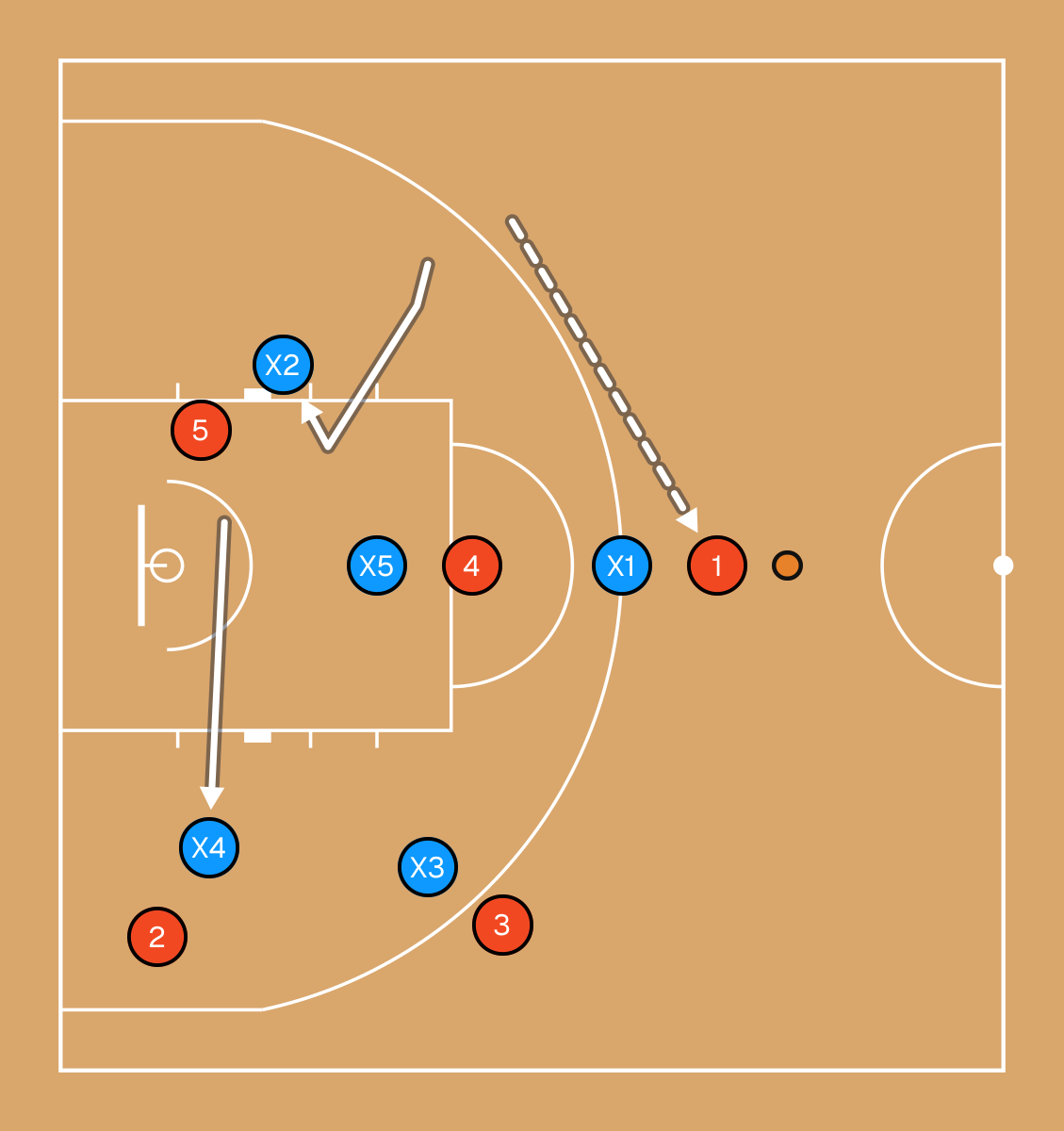
Start in a 2-3: X1 and X2 up top, X3 low left, X4 low right, X5 in the middle. Each takes the attacker nearest their area. Against a 1-3-1, X1 steps up to 1 at the point, X2 slides to 2 on the right wing, X3 moves up to 3 on the left wing, X5 steps up to 4 at the high post, 15 feet from the backboard, and X4 takes 5 on the block.
- 2
Guard the ball man-to-man
Whoever is closest when the ball is caught guards it at arm's length, chest square to stop the straight-line drive, while the zone behind helps. Everyone else sits a step toward the ball side of their area.
- 3
Pass cutters to the next defender
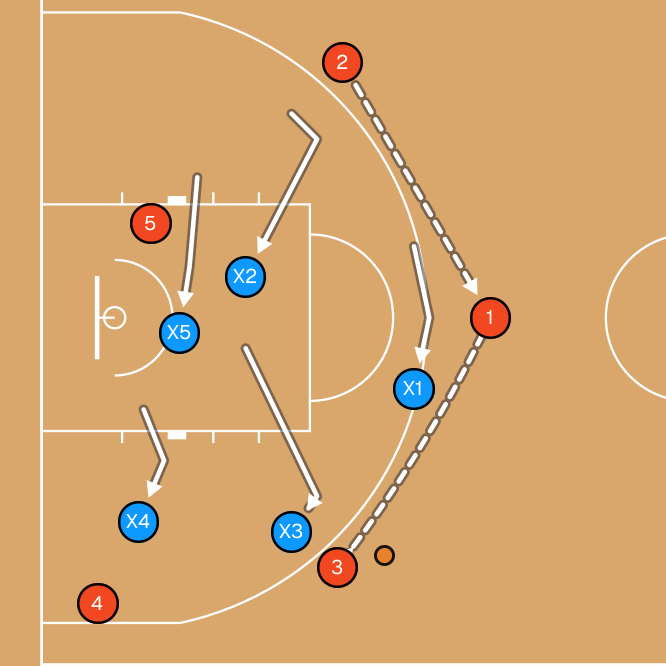
When 2 passes back to 1 and cuts through the lane toward the left side, X2 follows into the lane, calls "through", and releases the cutter at the far lane line to X4, the low defender, who slides across and calls "got him". Nobody trails a cutter all the way through; that turns a matchup into a broken man-to-man.
- 4
Fill the open spots
After a hand-off, count attackers and defenders. X2 drops to 5 on the right block, the spot X4 just left, X1 stays on the ball, and X3 and X4 split the two attackers now on the left side, one high and one low. One big always stays between the ball and the rim.
- 5
Change from man to zone on the call
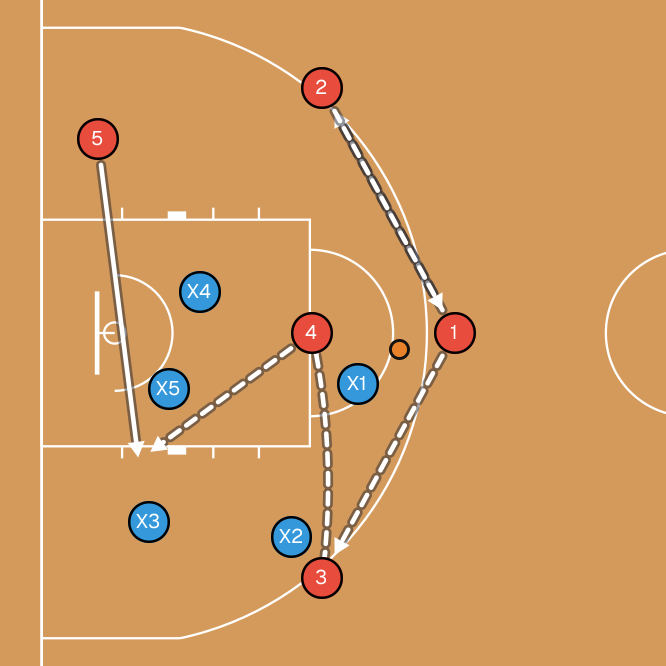
After a made basket, sprint back and pick up man-to-man. On the zone call, each defender sinks to their 2-3 spot as the ball crosses half court, so the offense reads man until the last second. After a miss, stay in man. The head coach calls it from the bench and the point guard repeats it.

In this play
Matchup zone: change from man to zone on the call
Changing from man-to-man to zone on a call: five defenders start matched man-to-man on a five-out set, then sink into 2-3 zone spots as 1 passes to 2, with X2 staying on the ball.
- The defense starts in man-to-man, each defender on one attacker in a five-out set.
- On the call, 1 passes to 2: X2 stays on the ball while X1 drops to the high post and X3, X4 and X5 sink into the back line of a 2-3 zone.
- 6
Build a simple call system
Name defenses by number or color, such as "red" for man and "blue" for matchup zone, with a hand signal for loud gyms: a fist for man, an open palm for zone. Practice weekly in a 4-on-4-on-4 drill or against a scout team, with the coach calling changes at random.
| Situation | What to call | Why it works |
|---|---|---|
| Opponent on a run, out of a timeout | Matchup zone | A new look breaks their rhythm |
| Your best defender has 3 fouls | 2-3 or matchup zone | They guard an area, not the ball one-on-one |
| Their star drives at will | 2-3 zone | Every drive meets a second defender in the lane |
| They can't shoot from outside | 2-3 zone, sagging | Dares them to make jumpers while the paint stays packed |
| You need to slow the tempo late | Matchup zone | More passes before a good look use up the shot clock |
| After a made free throw | Any zone | Time for every defender to reach their spot |
| Against a team that hasn't practiced against zone | Zone for a stretch | Unprepared offenses pass around the outside instead of attacking gaps |
Coaching points
Talk is the defense: "ball", "through" and "got him" on every hand-off, loud enough for the far side to hear.
Teach a regular 2-3 first, then add the matchup rules one at a time.
There are no fixed rebounding spots, so every defender boxes out the nearest attacker on the shot.
The ball defender still draws reach-in fouls; move feet, not hands.
Variations
2-3 matchup zone
The most common version: match one-guard fronts such as the 1-3-1 or 1-4 by pushing a guard to the point and a forward to the wing. Two defenders stay near the rim, which suits a team with size.
1-2-2 or 3-2 matchup against two-guard fronts
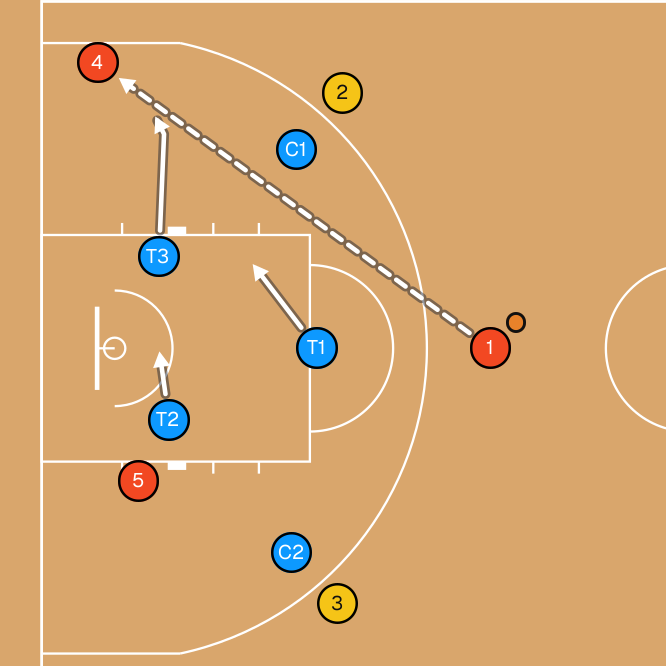
Against two guards at the top, a 1-2-2 or 3-2 base meets both guards and a wing without long closeouts. The two low defenders share the high post and both blocks, so use it against teams that shoot more than they post up.
Build it in Coach Board
The hand-off works when both defenders know exactly where it happens. In Coach Board, place the 1-3-1 and your five defenders on a half-court board, then animate the reversal and the cut step by step so players see X2 release the cutter. Duplicate the board for the man-to-zone call, scrub through the sink to the 2-3 spots, keep both in a playbook folder and share the link so players watch it on a phone or iPad before practice.
Drawing your own plays? Use the basketball play maker.
Start 7-day free trial →No card required
Questions coaches ask
What is a matchup zone defense?
A matchup zone defense is a zone that changes shape to match the offense's alignment. The defender on the ball plays man-to-man, the off-ball defenders guard areas, and cutters are handed from one defender to the next instead of being followed. To the offense it looks like man-to-man, but zone help stays in the lane.
How do you switch from man to zone during a game?
Switch from man to zone with one short call, such as a color or a number, made by the coach and repeated by the point guard. The team picks up man-to-man in transition, then each defender sinks to a zone spot as the ball crosses half court. Practice the call every week with a scout-team drill so it holds up under pressure.
How do you beat a matchup zone?
Beat a matchup zone by making the hand-offs hard: cut through the lane, screen the defender who should receive the cutter, and overload one side so two attackers arrive in one area. Skip passes and quick ball reversal stretch the matchups, and pushing the ball in transition lets you attack before the defense has matched up.