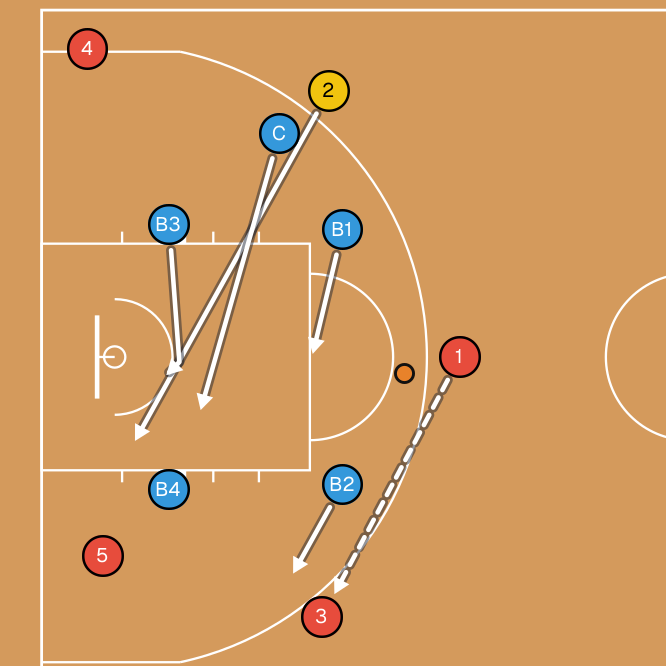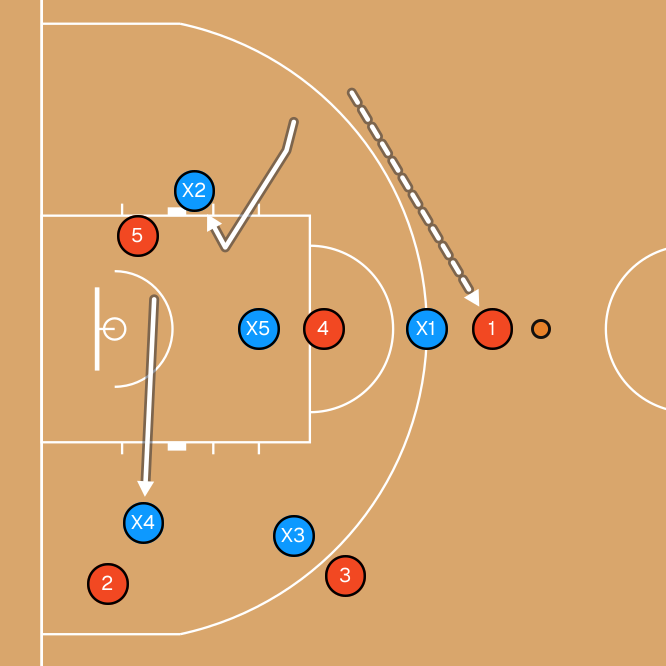


A triangle-and-2 defense splits your five into two jobs. Two chasers deny the opponent's two best scorers everywhere on the half court, and three defenders hold a triangle zone, one at the free-throw line and two beside the blocks. Coaches call it when a pair of players carries the scoring and the other three rarely hurt you from outside.
The bet is simple: you would rather watch their third-best shooter take a 20-foot jumper than let either star get loose. The paint stays crowded, but the perimeter away from the scorers is open by design, so it works best as a surprise against teams that have not prepared for it.
Objective
Keep the ball away from the two best scorers and make the other three beat a compact triangle from outside.
Setup
- Area
- Half court
- Players
- 5 defenders vs 5 attackers, with the two scorers in colored bibs
- Equipment
- 1 ball, bibs in two colors, cones at the free-throw line and both blocks
- Duration
- 15–20 minutes
How it works
- 1
Set the triangle
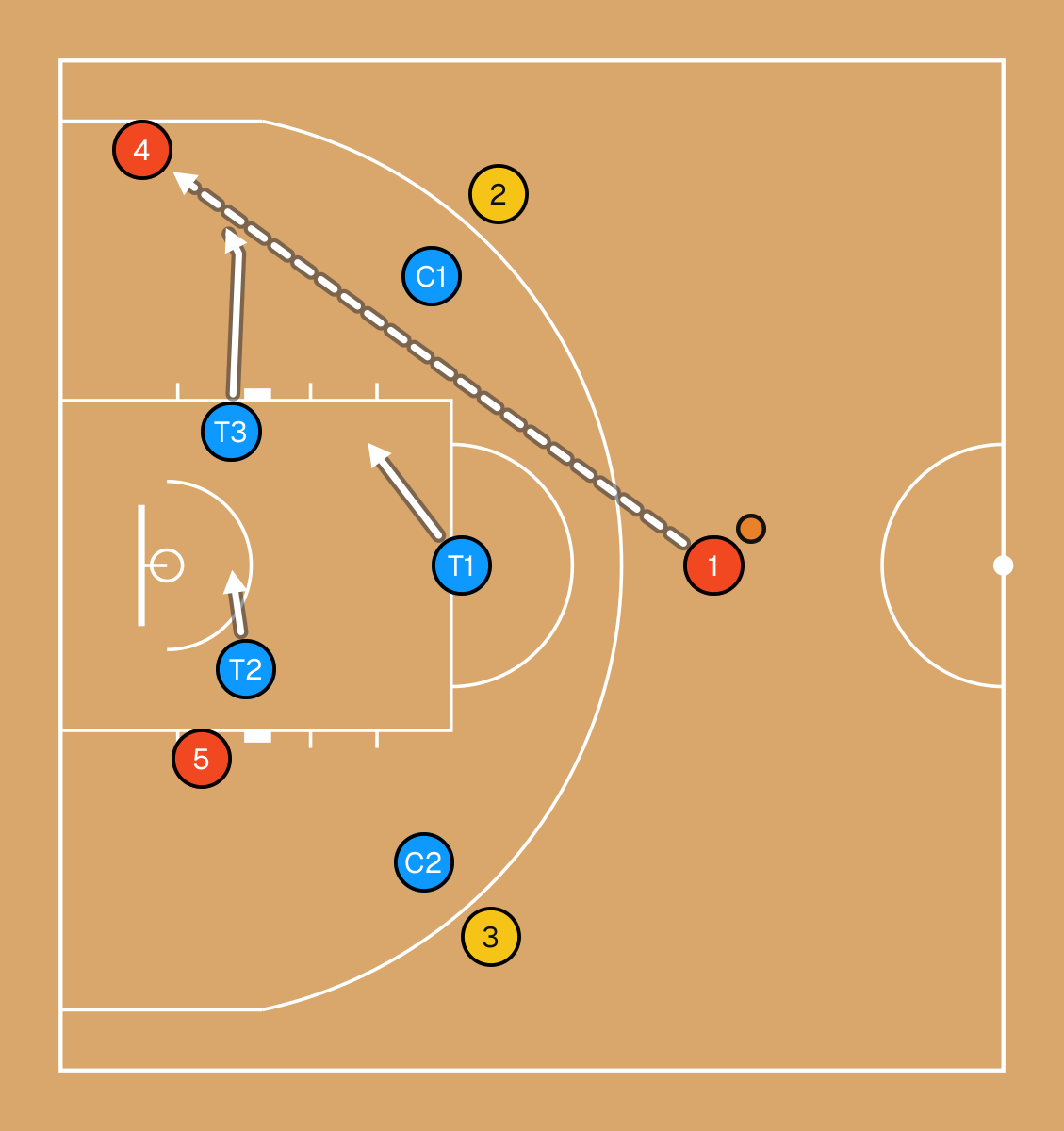
T1, a long guard or your most mobile forward, stands at the middle of the free-throw line, 15 feet from the backboard. T2 and T3 start a step outside each block, about 9 feet either side of the basket, hands in the nearest passing lanes. If the base spreads much beyond the lane lines, gaps open in the middle.
- 2
Assign the two chasers
C1 picks up 2 on the right wing and C2 picks up 3 on the left wing, and each stays with that scorer anywhere on the half court. Off the ball, chasers face-guard with one arm in the passing lane. On a catch, the chaser pushes the first dribble toward the triangle, never toward open floor.
- 3
Rotate the triangle on ball movement
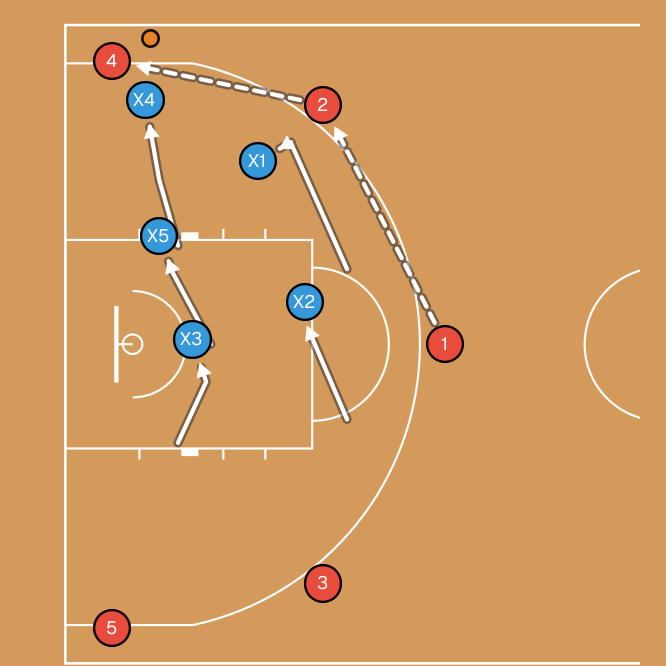
With 1 at the top, T1 closes out to the ball above the free-throw line. When 1 passes to 4 in the right corner, T3, the ball-side block defender, closes out with a high hand and takes away the baseline. T2 slides from the weak-side block to the middle of the lane, and T1 drops to the ball-side elbow to wall off the high post. On the pass back out, all three return to the base triangle while the ball is in the air.
- 4
Give up the right shot
Three defenders cannot cover every perimeter spot, so decide before tip-off which shots you will allow. Concede jumpers to the two weakest shooters, closing out short without fouling, and never concede a layup or a clean look for the scorers. If a non-scorer hits two or three in a row, adjust rather than keep gambling.
- 5
Help on the scorers without switching
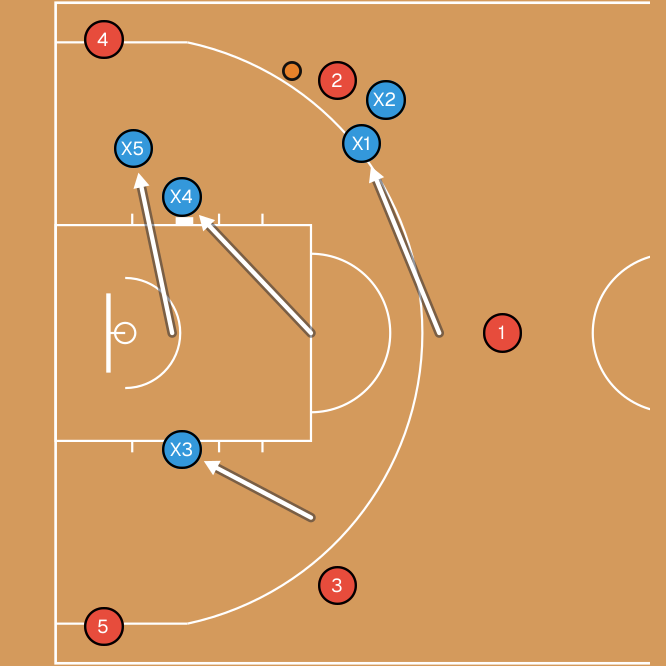
When 2 or 3 cuts through the lane or curls off a screen, the nearest triangle defender bumps the cutter, calls "bump", and holds for one count while the chaser recovers, then returns to their spot. Triangle players never keep a scorer, and chasers never sink into the lane to help on someone else.
| Defense | Zone players and shape | Chasers | Use it when | Weak spot |
|---|---|---|---|---|
| Triangle-and-2 | Three: one at the free-throw line, two beside the blocks | Two | Two scorers carry a team of weak shooters | Perimeter away from the scorers, corners |
| Box-and-1 | Four: two near the elbows, two near the blocks | One | One perimeter star with little help | High post and wings |
| Diamond-and-1 | Four: one high, two mid-lane, one at the rim | One | One star plus a high-post threat | Corners |
| Inverted triangle-and-2 | Three: one at the rim, two at the elbows | Two | Two scorers plus shooters in the slots | Blocks and short corners |
Coaching points
Pick chasers for quick feet, stamina and foul discipline; tired or fouled-up chasers end the plan fast.
Chasers fight over every screen and call it early so the nearest triangle defender can show a hand.
On the shot, the triangle boxes out around the rim and each chaser blocks out their scorer.
The ball defender calls "ball" and the rim defender calls "middle" on every pass, and chasers find their scorers in transition before half court.
Variations
Inverted triangle-and-2
Flip the triangle so one defender stays at the rim and two sit at the elbows. The high pair closes out faster to the slots and the top, which helps against good 20-foot shooters, but a post player who catches deep has only one defender near them.
Switch to it for a few possessions
Use it as a change-up, not a base defense: out of a timeout, after a made free throw when you have time to set up, or for the first trips of the second half. A handful of possessions can break the scorers' rhythm before the other bench adjusts.
Build it in Coach Board
Chasers and the triangle stay connected once every player has seen where the bump happens. In Coach Board, place both teams on a half-court board and animate the corner pass step by step so the triangle's three slides land on the same beat. Duplicate the board for the cut-through bump, file both under the opponent's name in your playbook, and share the link so players watch it on their phones before the game.
Drawing your own plays? Use the basketball play maker.
Start 7-day free trial →No card required
Questions coaches ask
When should you use a triangle-and-2 defense?
Use a triangle-and-2 defense when two opposing players score most of the points and the other three are weak shooters. It works best for short stretches, such as out of a timeout or after a made free throw, to break the scorers' rhythm. Against a balanced team with three or more shooters, a standard 2-3 zone or man-to-man covers the floor better.
How do you beat a triangle-and-2 defense?
Beat a triangle-and-2 by screening for the two scorers so their chasers get caught in traffic, and by overloading a corner, where one triangle defender must cover two spots. Put a shooter in the gaps of the triangle at the short corner or the high post. The three non-scorers must take and make the open shots the defense gives them.
Is the triangle-and-2 legal in high school?
Yes, the triangle-and-2 is legal in US high school and college basketball, where zone and combination defenses are allowed. In the NBA any defense is allowed, but a defender in the lane must actively guard someone within three seconds (Rule 10, Section VII). Youth leagues following the NBA and USA Basketball youth guidelines play no zone at ages 7 to 11.