

The Y passing drill is a staple of German and Dutch academy curricula: a cone layout shaped like the letter Y that grooves the bounce pass, the set-and-spin and the ball played "round the corner", the exact combinations a team uses to break a midfield line through its striker or pivot.
Its appeal is efficiency. Unopposed pattern work lets a squad bank dozens of quality repetitions of a match-specific sequence in minutes, every player rehearsing both the wall pass and the checked run. Where a rondo trains perception, the Y trains execution. The two belong in the same technical block.
Objective
Groove line-breaking combinations (bounce passes, set-backs and balls round the corner) with precise weight, first-touch direction and run timing on both sides of the body.
Setup
- Area
- Roughly 15x12m: base cone A, cone B 8m directly ahead, cones C and D 6m beyond B at 45 degrees either side
- Players
- 8 or more: a queue at A, one player each at B, C and D
- Equipment
- 4 cones (mannequins at B if available), 3–4 balls at the base cone, Bibs only if running two grids in competition
- Duration
- 12–15 minutes within a technical block
How it works
- 1
Build the Y
Place cone A at the base with the ball queue, cone B 8m up the middle, and cones C and D branching 6m further at 45 degrees left and right. A mannequin behind B simulates the marker on the target player's back.
- 2
Run the basic pattern
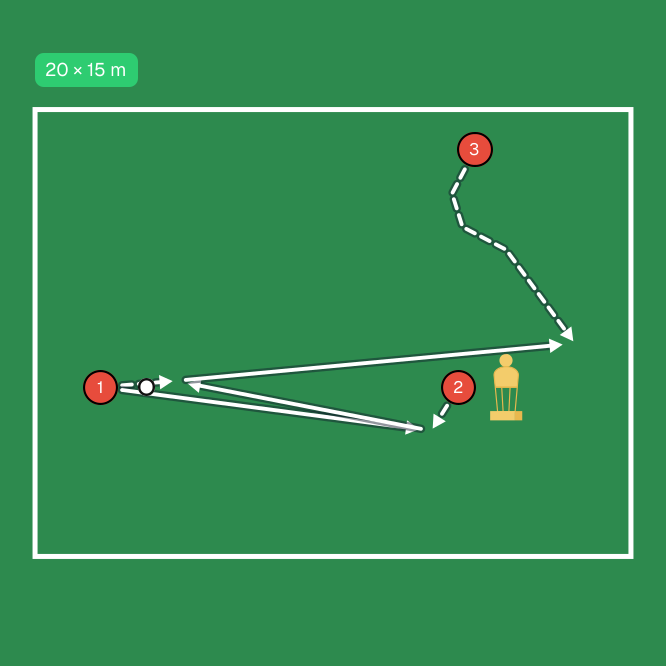
A drives a firm pass into B, who has checked away from the mannequin and come short. B sets the ball back at an angle with one touch, and A plays first time round the corner to C, who timed a short movement off his cone to receive on the move.
- 3
Rotate through the shape
Everyone follows their pass: A jogs to B, B pushes on to C, and C carries the ball back to the queue at A. Alternate the final pass between C and D each round so the pattern opens out to both sides.
- 4
Switch the combination
After five minutes, change the picture: B lets the set-back run across his body and spins in behind the mannequin, and A's second pass finds the spin instead of the wide cone.
- 5
Release the third man
Final progression: A plays into B, B sets to A and A hits C. As that pass travels, B spins beyond the mannequin so C can slide him in first time. That is the third-man release the drill has been building toward.

In this play
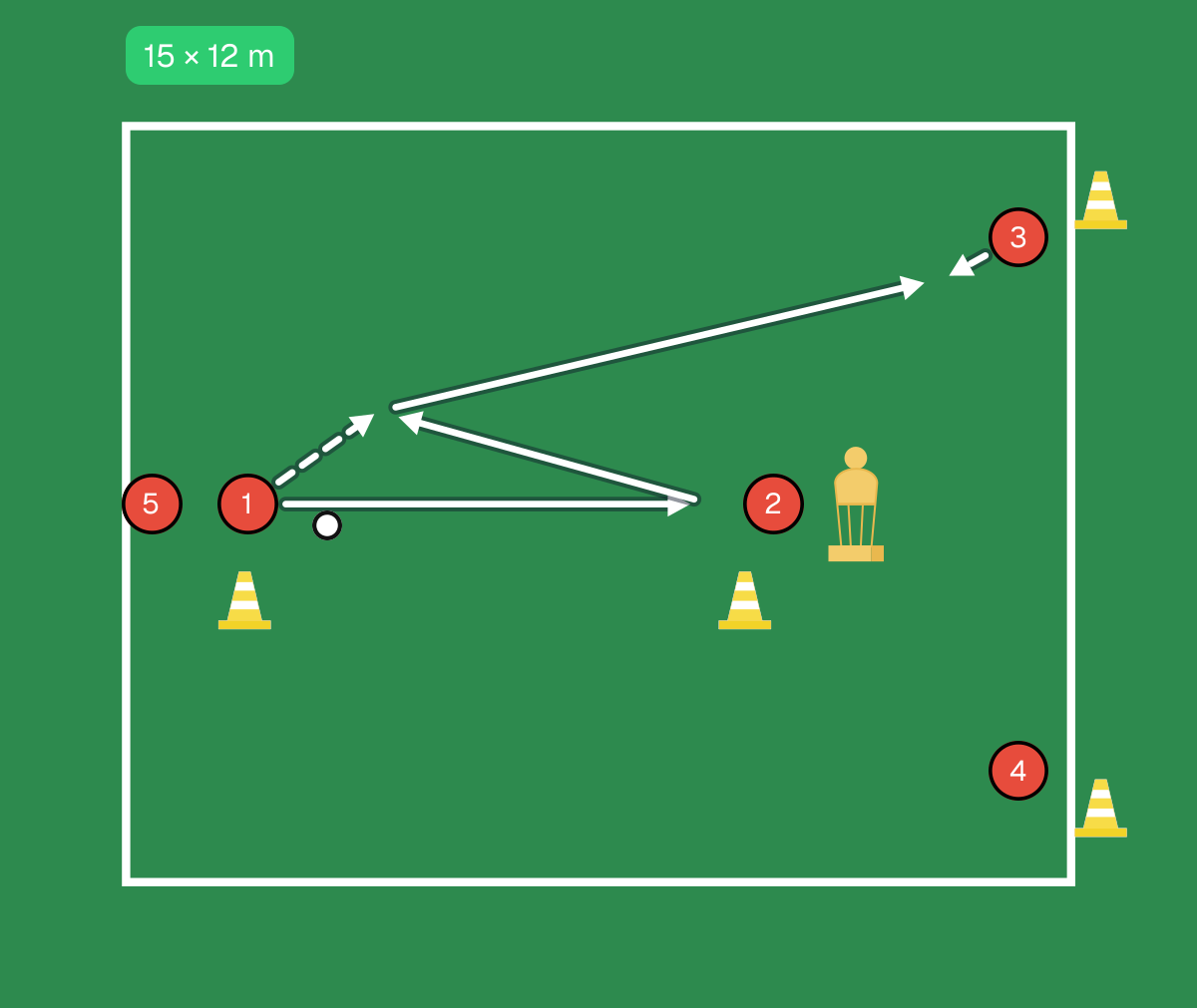
Y passing drill: the third-man release
The final Y passing progression: A plays into B, B sets back to A, A hits C, and as that pass travels B spins in behind the mannequin so C can slide B in first time, the third-man release the drill builds toward.
- B (2) comes short and A (1) drives the ball into B.
- B sets the ball back to A, who has stepped across.
- A hits C (3), and as the pass travels B spins in behind the mannequin.
- C slides B in first time: the third-man release.
Coaching points
Check away hard before coming to meet the ball. The two meters of separation created by that fake is what makes the bounce pass playable.
Set-backs are cushioned with the instep at an angle, into the path of the incoming player, never straight back down the line the pass came from.
Receive side-on at the branch cones so the ball can travel across your body and onward in a single touch.
The run beyond must start while the set-back is traveling. Leaving after the ball is released kills the third-man timing every time.
Variations
Live defender at B
Replace the mannequin with a semi-active defender who can intercept slack passes and sloppy sets. Angles and touch quality become real decisions rather than choreography.
Y into finishing
Point the Y at goal 25m out. The final pass slides the spinning player into the box for a finish, and the whole rotation resets: technical pattern work with a payoff that keeps strikers honest.
Build it in Coach Board
Build the Y in Coach Board with cone objects and the exact 8m and 6m spacings, then animate ball arrows and player runs on separate beats so the set-back and the spin visibly happen in sequence. Duplicate the board mirrored to the other side and share both, so your players arrive already knowing the rotation.
Setting up your own drills? Use the football session planner.
Start 7-day free trial →No card required
Questions coaches ask
What does the Y passing drill actually improve?
It trains the combinations teams use to play through midfield: passing into a marked target player, one-touch set-backs, receiving side-on to play round the corner, and timing runs off a teammate's set. It also builds passing tempo and first-touch discipline on both feet.
How many players do you need for a Y drill?
Eight is comfortable: a small queue at the base plus one player at each working cone keeps rest short without crowding. With twelve or more, build a second Y and run the two grids as a competition rather than lengthening the queue.