




Walk past almost any professional training ground twenty minutes before a session and you will see circles of players pinging a ball around two chasing teammates. That is the 5v2 rondo, football's universal warm-up. It descends from the playground game of piggy-in-the-middle, but at La Masia and Ajax's De Toekomst it was refined into a daily ritual with strict technical demands.
The extra outfield player compared with a 4v2 changes the exercise's character. There is always a spare man somewhere, so the challenge stops being survival and becomes selection: can you find the free teammate one pass before he is obvious? That makes the 5v2 the natural home for teaching the third-man idea and for grooving first-time combinations at match tempo.
Because failure is rarer and the mood is competitive-but-playful (nutmegs on the defenders are traditionally celebrated loudly), it also does social work, switching a squad on mentally before the harder blocks of the session.
Objective
Warm players up with high-volume passing while training them to locate the spare man early, combine first time through central lanes, and defend in pairs with coordinated pressing runs.
Setup
- Area
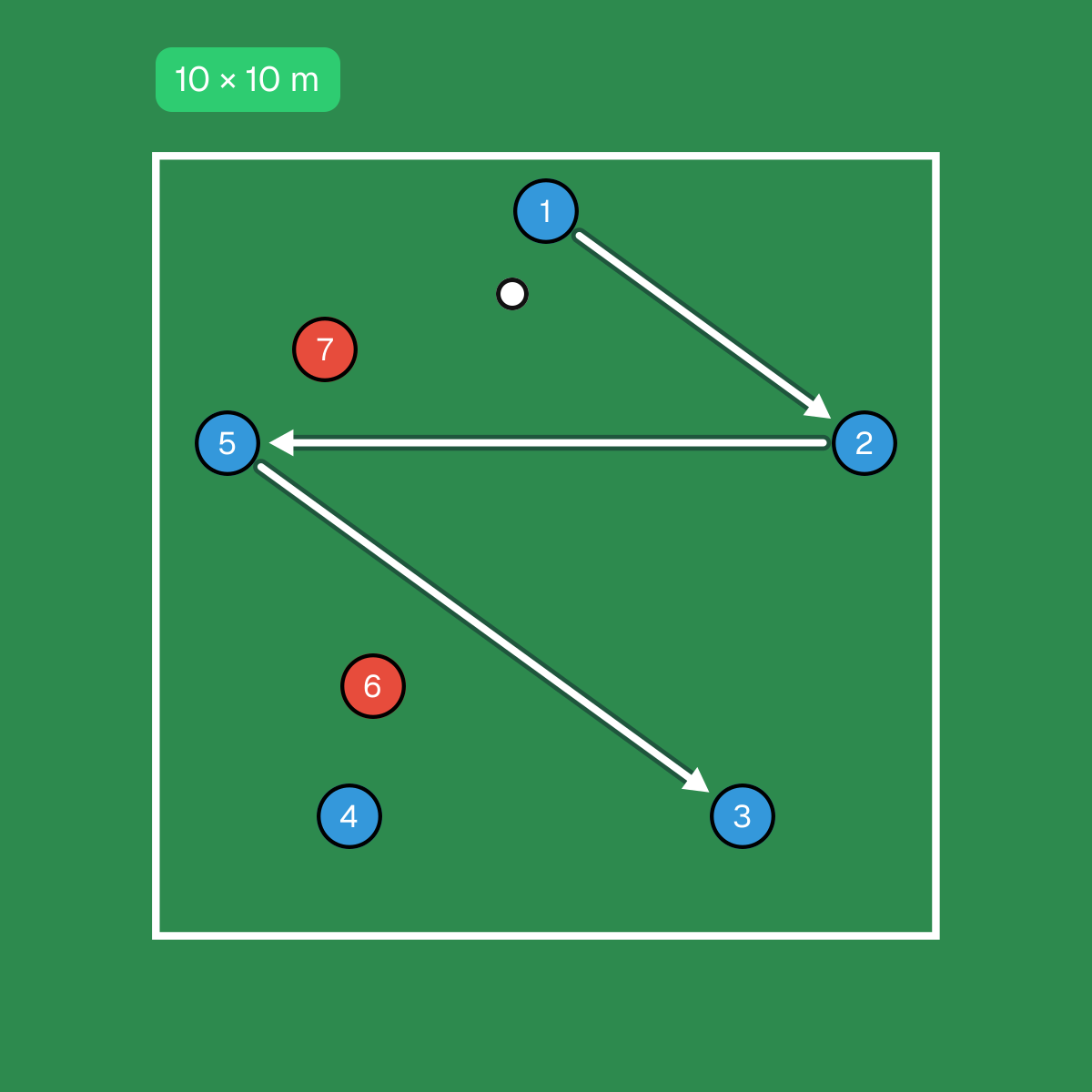
- 10x10m square or a circle roughly 10m across
- Players
- 7: five on the perimeter, two defenders in the middle
- Equipment
- 4–6 flat markers to sketch the boundary, 1 ball with several spares, 2 bibs
- Duration
- 8–12 minutes at the start of the session
How it works
- 1
Shape the perimeter
Space five attackers evenly around a 10x10m boundary. A circle works just as well and encourages constant micro-adjustments. Two defenders begin in the center; everyone else stays off the grid to keep the ratio honest.
- 2
Open at two touches
For the first three minutes allow two touches so bodies warm up and passes find their range. Insist the ball never stops: a dead ball means the nearest spare ball is played in immediately.
- 3
Rotate the middle on a clock
Swap the defending pair every 45–60 seconds rather than on every turnover, so the two inside commit to genuine pressing bursts instead of pacing themselves.
- 4
Introduce scoring
Fifteen consecutive passes is a point for the outside; a nutmeg through a defender wins the round outright. Defenders log a point for each regain, and the losing pair collects the equipment at the end. Small stakes keep the tempo up.
- 5
Finish at one touch
Close the final three minutes with one-touch play. Sequences will shorten, but the scanning and preparation this demands is exactly the state you want players in as the session proper begins.
Coaching points
Take up positions on the half-turn where possible, hips open across the grid, so a first-time pass to the far side is always available.
Weight passes to the receiver's safe foot (the one furthest from the pressing defender) and firm enough to beat the second defender's reach.
Look for the free man a pass ahead: when the ball travels left, the spare player usually appears on the opposite arc, not next door.
Neighbors of the receiver should talk constantly ("time", "man on", "turn") because the man in possession cannot see the whole circle.
Defend as a linked pair: the front man curves his run to force play one direction while his partner shifts early to ambush the next lane.
Variations
4+1 with a pivot inside
Move one attacker into the middle among the defenders. Passes into the pivot's feet that are laid off first time count double, converting the warm-up into a lesson on playing through a pressing block.

In this play
4+1 rondo: play through the pivot
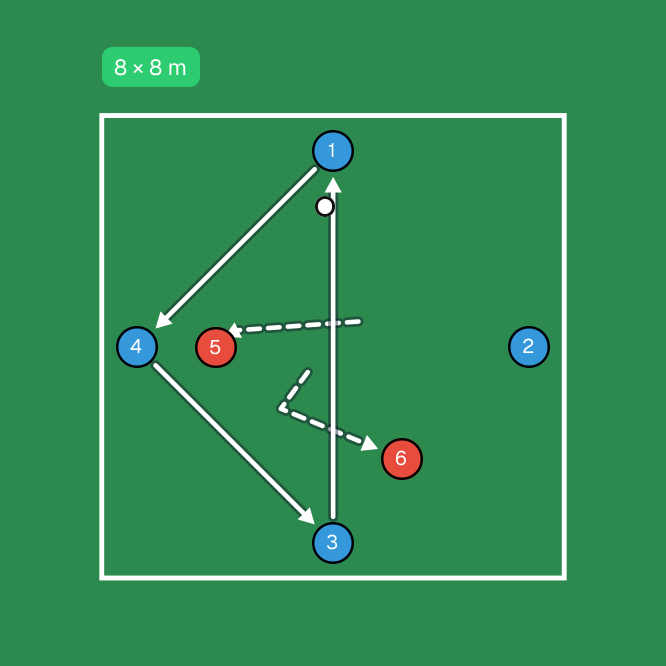
The 4+1 variation of the 5v2 rondo: one attacker plays as a pivot between the two defenders, takes the ball into his feet and lays it off first time through the press.
- Player 1 passes into the feet of the pivot, 5, as defender 6 steps in to press him.
- The pivot lays it off first time to player 4, away from the press.
- Player 4 plays round the press back to 1, and the pattern starts again.
Shrinking circle
Every time the outside completes fifteen passes, each attacker steps one meter in. The tightening space naturally escalates difficulty without the coach touching a cone.
Build it in Coach Board
Lay out a 10m circle of five blue dots with two reds inside on your Coach Board pitch, then animate the defenders rotating around the ball as it circulates. Export the short clip and drop it in the team chat the night before, so the warm-up organizes itself when players arrive.
Setting up your own drills? Use the football session planner.
Start 7-day free trial →No card required
Questions coaches ask
Is the 5v2 rondo too easy for advanced players?
Only if the constraints stay soft. At professional level the fix is a smaller circle, strict one-touch play and quick defender rotations. Many top squads run 5v2 daily for years precisely because those levers keep it endlessly scalable.
How long should the two defenders stay in the middle?
About 45–60 seconds, or two clean regains, whichever comes first. Turnover-based swapping alone lets tired defenders coast, while a timer guarantees short, honest pressing efforts that mirror match bursts.