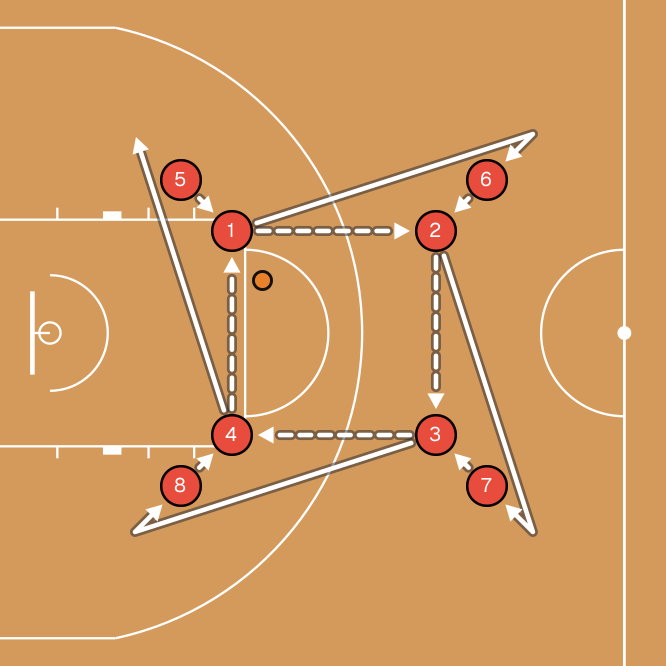



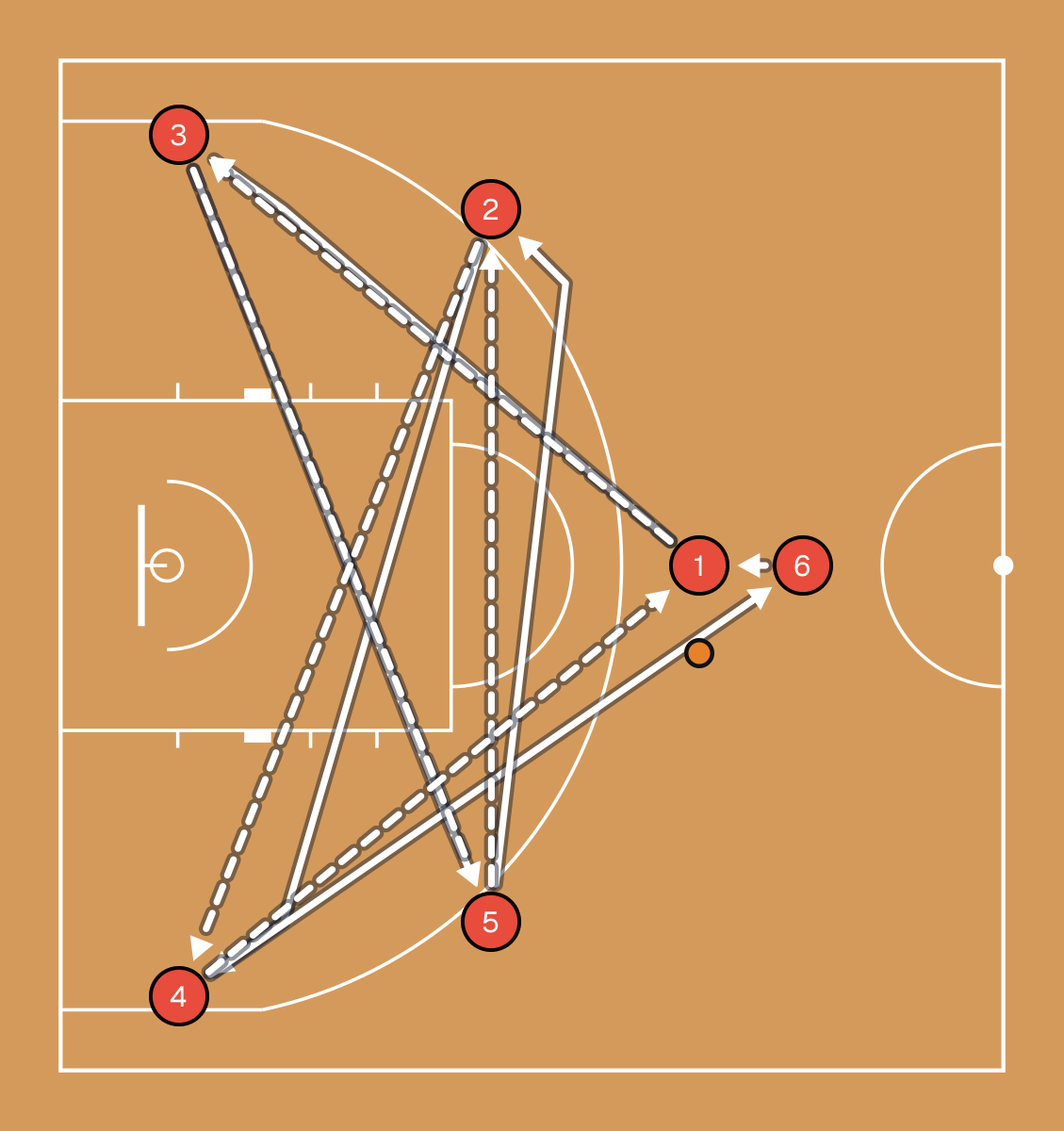
The star passing drill is a gym classic that hides real difficulty inside a pretty pattern. Five players stand at five spots spaced around the perimeter, and the ball travels across the circle in a five-pointed star (skipping the neighbor to hit the spot two along) while each passer follows their pass to the spot they just threw to. Watched from the stands the ball traces a clean star; run at speed it demands sharp passes, heads-up catching and constant movement.
Its staying power comes from packing passing, footwork, communication and conditioning into one continuous flow. Nobody stands still: pass, then sprint to fill the spot you fed, so the five players rotate endlessly around the star. That pass-and-follow engine makes it a favorite warm-up, and cranked up with a running clock it becomes a genuine conditioner that keeps the ball, and the fun, in the work.
The two-ball progression is where it earns its reputation. Add a second ball on the far side of the star and suddenly every player is catching one ball while another is already on the way, forcing early eyes, a quick turn, and a called name before every pass. It is one of the best drills going for teaching players to pass, receive and communicate under real time pressure.
Objective
Sharpen crisp passing on the move, heads-up catching and pass-and-follow spacing at speed, then layer a second ball to force communication and timing under pressure.
Setup
- Area
- Five spots spaced evenly around a half-court circle or arc
- Players
- 5 minimum, one per spot; extra players line up behind spots
- Equipment
- 1 ball to start, a second for the progression
- Duration
- 6–10 minutes
How it works
- 1
Set the five spots
Space five players evenly around the perimeter. Think the points of a star at the top, both wings and both corners. The wider the spacing the longer and sharper the passes have to be, so scale it to the group's age and skill.
- 2
Pass across the star
The ball always travels to the spot two along, skipping the immediate neighbor, so each throw crosses the circle and the ball's path draws a five-pointed star. Passers step into a firm chest pass on a line to the receiver's target hand, not a floated lob.
- 3
Follow your pass
The instant the ball leaves the hands, the passer sprints to fill the spot they just threw to, joining the back of that line. Pass and follow, every time: the ball and the players circulate the star together and no spot is ever left empty.
- 4
Add the second ball
Once the single-ball rhythm is clean, start a second ball two spots away from the first. Now a player catches one ball just as the next is arriving, so eyes come up early, the turn is quick, and the receiver's name is called before every pass.
- 5
Put a clock on it
For conditioning, run continuous rounds against a timer or a count of completed passes with no drops. A dropped ball or a missed target resets the count, so speed has to stay married to accuracy under fatigue.
Coaching points
Step into every pass and throw on a line to a target hand. A floated star pass across the circle is the easiest one to intercept or fumble.
Follow your pass immediately; a passer who admires the throw and jogs stalls the rotation and jams the spot behind them.
Eyes up and hands ready before the ball arrives, especially with two balls live; catching flat-footed is where drops and travels start.
Call the receiver's name before releasing so nobody catches a second ball unaware; communication is the drill's real teaching point.
Keep both balls on the same rhythm. If one round of the star drifts faster than the other, the two balls collide in the middle.
Variations
Reverse the star
On a whistle, flip the direction the ball travels around the star so players must react and re-read the pattern rather than running it on autopilot.
Bounce-pass star
Switch every throw to a crisp bounce pass across the circle, rehearsing the lower-arriving pass and demanding even more precise timing to a moving target.
Three-ball challenge
For advanced groups, add a third ball spaced evenly around the star. It's a demanding test of spacing, timing and communication that quickly exposes any late eyes.
Build it in Coach Board
Place five player tokens at the star points on a Coach Board half court and animate the ball skipping two spots along while each passer token slides to the spot it fed, so the star pattern and the pass-and-follow rotation appear at once. Add a second ball token two points away and press play to preview how the two balls chase each other around the circle before players attempt it live.
Setting up your own drills? Use the coach whiteboard.
Start 7-day free trial →No card required
Questions coaches ask
How does the star passing pattern work?
Five players stand at five spots around the perimeter and the ball is passed to the spot two along, skipping the immediate neighbor, so each pass crosses the circle. Repeated around the group, the ball's path traces a five-pointed star. Each passer then follows their pass to the spot they fed, so the players rotate around the star along with the ball.
Why add a second ball to the star drill?
A second ball turns a rhythmic warm-up into a real pressure test. With two balls circulating, a player is catching one just as the next is on its way, which forces early eyes, a quick turn and a called name before every pass. It is one of the best ways to train passing, catching and communication at genuine game speed without needing a defender.
Is star passing a good conditioning drill?
Yes. Because every player follows their pass and sprints to a new spot, nobody stands still, so run continuously against a clock it keeps the whole group moving and the heart rate up. Adding a second ball or a completed-pass target with no drops raises the intensity further, making it a conditioner that keeps a ball in players' hands rather than just running lines.