



Most teams treat sideline out of bounds as a throwaway possession: get it in, run offense. That wastes a set piece where four defenders must guard cutters without seeing the ball, and where the inbounder becomes a scoring threat the moment the pass leaves his hands. Good SLOB packages win close games, where every late possession is inbounded.
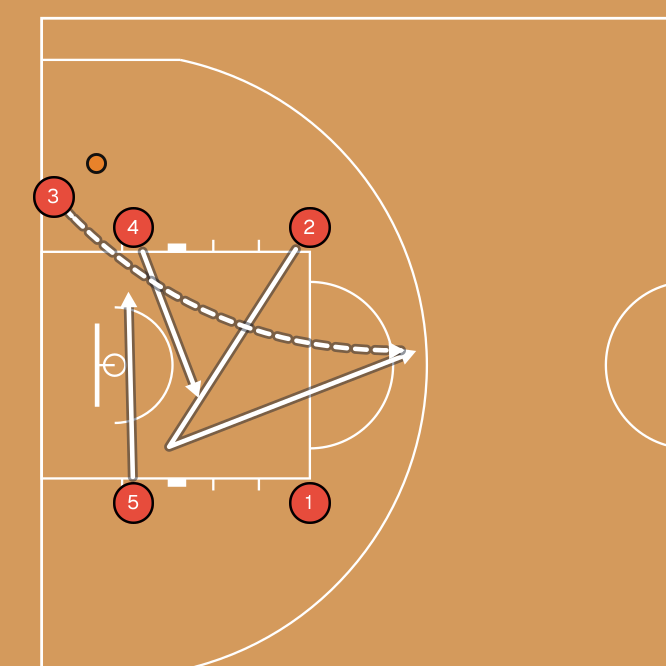
The stack lines four players vertically in front of the inbounder, from the ball-side elbow down toward the block. From that column you get three calls: an entry that beats pressure, a pin-down three, and a back-screen lob. The defense can't tell them apart until the stack breaks.
Objective
Build a sideline out-of-bounds package that beats denial pressure, produces a catch-and-shoot three, and creates a rim finish from one shared alignment.
Setup
- Area
- Half court, ball out of bounds on the sideline near the hash
- Players
- 5 offensive players; progress to 5v5 with the defense denying everything
- Equipment
- 1 ball
- Duration
- 10–15 minutes per install block
How it works
- 1
Form the stack
2 takes the ball out at the sideline hash. 1, 5, 3 and 4 stack vertically facing him, spaced an arm's length apart, top of the stack at the ball-side elbow. The slap breaks the stack; until then nobody leans.
- 2
Call 1: Safe entry vs pressure
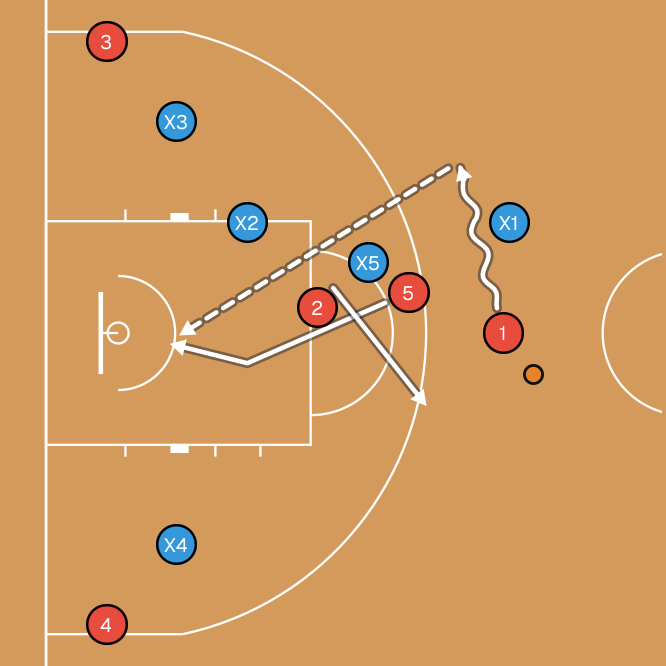
On the slap, 1 pops straight toward the ball, 4 sprints back as the deep safety, and 5 screens 1's defender if the denial is heavy. 2 hits 1, then immediately cuts off 5's back screen to the rim. The inbounder's give-and-go is the sneakiest scorer on any SLOB.
- 3
Call 2: Pin-down three
The stack splits: 1 clears to the weak wing dragging his defender while 5 and 4 double pin-down for 3, who curls from the bottom of the stack to the ball-side wing. 2 hits 3 on the move; if x3 shoots the gap, 3 fades to the corner instead.
- 4
Call 3: Back-screen lob
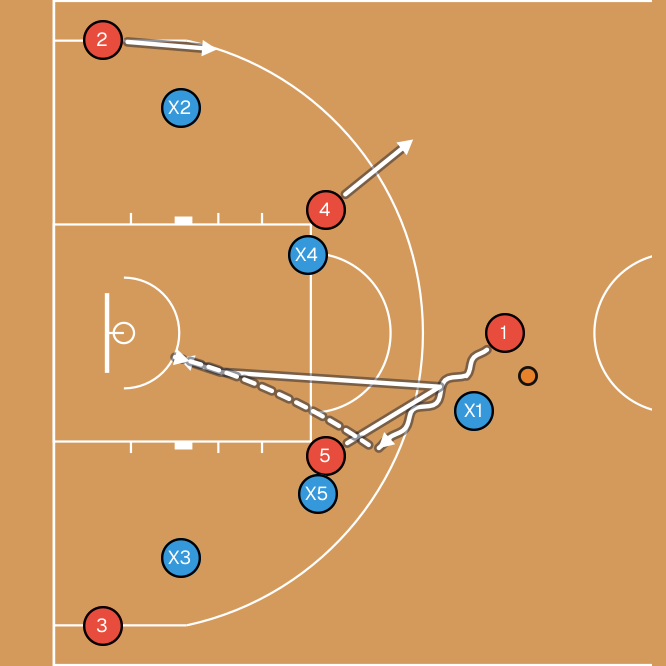
1 pops for the entry as bait. Just as 2 fakes toward him, 3 back-screens x5 at the elbow and 5 leaps to the front of the rim for the lob. Save it for late clock, when the defense relaxes. The pass must be in the air before 5 clears the screen.

In this play
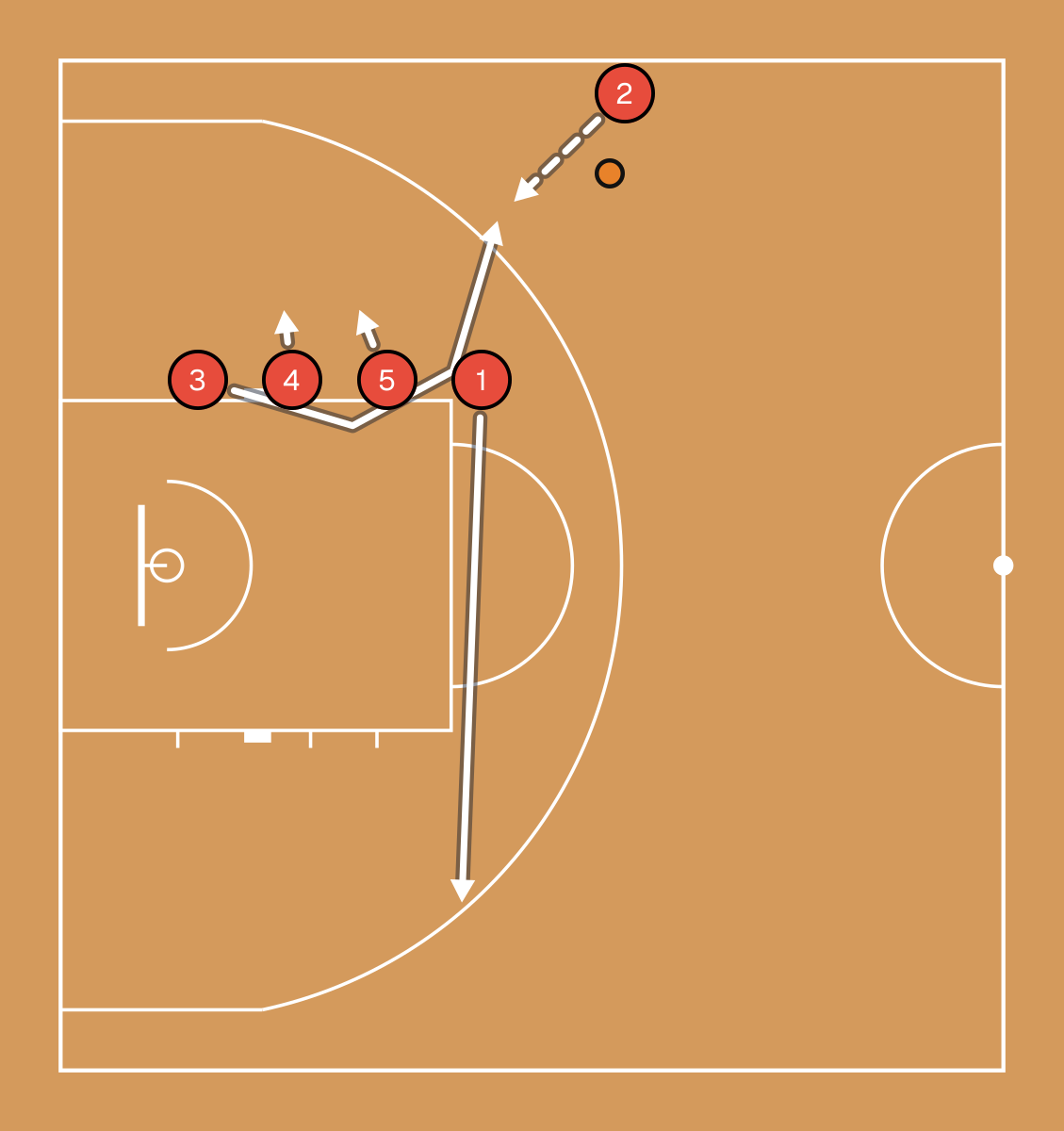
SLOB stack: back-screen lob
The stack's late-clock call: 1 pops as bait, 3 back-screens for 5 at the elbow, and the lob is in the air before 5 clears the screen to the front of the rim.
- Player 1 pops toward the ball as bait, 4 sprints back as the safety, and 3 comes up to back-screen 5's defender at the elbow.
- 5 cuts off the back screen to the front of the rim as inbounder 2 throws the lob.
- 5
Read the denial
When everything is face-guarded at four seconds, 4 flashes from safety to the ball-side elbow, the spot the defense concedes. Enter to 4; the guards split-cut off him while 5 seals low.
Coaching points
Pick an inbounder with size and patience; a hurried five-foot passer turns every SLOB into a turnover risk.
Cutters must change pace: walk into the screen, sprint out of it. Constant-speed cuts are effortless to track.
The inbounder never stands and watches after passing: step in and cut, or drift weak side for the swing-swing three.
Always designate the safety before the slap so a blown-up play costs you a possession, never a layup the other way.
Variations
Late-clock need-a-three
Replace the lob call with an elevator: 3 sprints from the weak corner between 4 and 5, who close the gate behind him at the top of the key for the catch-and-shoot.
SLOB vs zone
Against a 2-3, stack overloads the ball side automatically: 3 slides to the short corner, 5 screens the zone's middle, and 2 inbounds high-low off the shifted back line.
Build it in Coach Board
Lay the stack out once in Coach Board and record the three calls as separate animations on duplicated boards, all starting from the same frozen frame. Play the first two seconds of each clip side by side to prove the defense cannot pre-read the call, then share the links so players learn the triggers on their own time.
Drawing your own plays? Use the basketball play maker.
Start 7-day free trial →No card required
Questions coaches ask
What is a SLOB in basketball?
SLOB stands for sideline out of bounds, a restart where the ball is inbounded from the sideline rather than the baseline. Teams use set plays on SLOBs because the defense must guard four moving players while the passer is unpressured, which creates screening chances a normal possession doesn't offer.
Who should inbound the ball on sideline plays?
Your best decision-maker with good size, often a forward who can see over the denial and deliver over the top. The inbounder also becomes a scoring threat on the give-and-go after entering the ball, so avoid a player the offense never intends to involve.